
-
We’re currently investigating an issue related to the forum theme and styling that is impacting page layout and visual formatting. The problem has been identified, and we are actively working on a resolution. There is no impact to user data or functionality, this is strictly a front-end display issue. We’ll post an update once the fix has been deployed. Thanks for your patience while we get this sorted.
You are using an out of date browser. It may not display this or other websites correctly.
You should upgrade or use an alternative browser.
You should upgrade or use an alternative browser.
Discussion M5 series GPU discussion
- Thread starter poke01
- Start date

poke01
Diamond Member
The M5 GPU architecture “Apple10” is a much more area performant architecture and each GPU core is properly utilised leading to huge uplifts in rasterisation and in ray traced workloads even more than M3 -> M4 which introduced RT cores. It also includes tensor cores useful for prefil and Topez etc.For those of us who don't pay deep attention to GPU architectures, what sets M5 GPU apart from earlier ones? What did the earlier GPUs lack?
The performance per watt is also very good. Previous architectures from Apple lacked good PPA and had weak performance for the price you paid relative to dGPUs from Nvidia. The Pro and Max variants should scale well and offer a better overall package now.
I could go further into detail but it’s better to wait till next week where we can see actual tests.
poke01
Diamond Member
amd has something simliar comingDynamic caching is an impressive tech. It is surprising that the industry has not paid much attention to it.
Where can I read about this?amd has something simliar coming
poke01
Diamond Member
I think it was talked about in the RDNA5 thread couple weeks backWhere can I read about this?
So, is this just rumours and speculation, or are there already patents?I think it was talked about in the RDNA5 thread couple weeks back
poke01
Diamond Member
Post in thread 'RDNA 5 / UDNA (CDNA Next) speculation'So, is this just rumours and speculation, or are there already patents?
https://socialtechwork.com/threads/rdna-5-udna-cdna-next-speculation.2624468/post-41497631
It looks like speculation
I haven't had time to do much more than look at the highlights for new new M5 MBP from threads here, but I was intrigued by the reported uplifts in graphics improvements.
The posts here have certainly helped to explain why it's such a large jump despite the paper specs not suggesting as much of an uplift.
The posts here have certainly helped to explain why it's such a large jump despite the paper specs not suggesting as much of an uplift.
poke01
Diamond Member
yea it’s smart design. Increasing performance without increasing GPU area/adding more cores so the cost doesn’t balloon.I haven't had time to do much more than look at the highlights for new new M5 MBP from threads here, but I was intrigued by the reported uplifts in graphics improvements.
The posts here have certainly helped to explain why it's such a large jump despite the paper specs not suggesting as much of an uplift.
My expectation is that the 10 core M5 GPU should be on par with the 14 core M3 Pro in GPU bound tasks.
poke01
Diamond Member
Investigating the GPU Neural Accelerators on Apple A19/M5
 tzakharko.github.io
This is a break down of the new GPU core in M5/A19 by “leman”.

If this increase extends to the entire M5 chip line, there is a chance that the M5 Max could match or even surpass the 5090 laptop.Blender GPU score (62% faster than M4, on par with M3 Pro (18-core GPU), faster than 3050)
View attachment 132197
That's still only a single sample but that score is ahead a 9060XT and below B570 for Blender 4.5.Blender GPU score (62% faster than M4, on par with M3 Pro (18-core GPU), faster than 3050)
View attachment 132197
I wonder if Apple's GPU architecture roadmap is consistent with what Imagination is doing with its PowerVR GPU architecture? By a strange coincidence, in May of this year, Imagination presented a new architecture that offers a 35% improvement in energy efficiency (which almost matches the energy efficiency curves in Geekerwan's A19 Pro review) and has a built-in Neural Core that provides 4 times more performance in AI computing, which also matches Apple's Neural Accelerator.
 www.imaginationtech.com
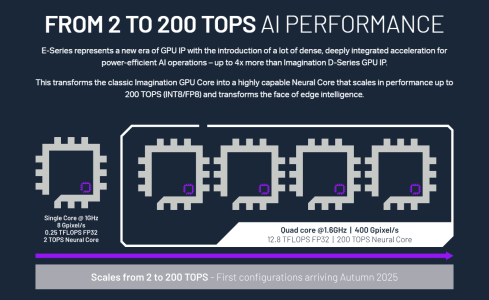
"Imagination’s PowerVR GPU architecture is renowned for its energy efficiency and has been deployed in power-constrained devices for nearly twenty years. The E-Series’ new Burst Processors technology enhances power efficiency by a further 35% for AI workloads, games and user interfaces. This improvement is achieved by reducing pipeline depth and minimising data movement within the GPU."
"E-Series continues to offer the advanced graphics capabilities of previous generations of Imagination GPUs, including support for ray tracing. To this, it adds deeply integrated acceleration for power-efficient, low precision AI operations into every GPU core. This creates the compute-dense E-Series Neural Cores that scale up to 200 TOPS INT8 and unleash up to 400% the AI performance of the previous D-Series. The Neural Cores support a wide range of popular AI number formats, enabling developers to design networks that meet a broad spectrum of performance, accuracy and power demands. One of their many performance efficiency measures is an AI-friendly memory architecture that prioritises local memory for compute, greatly reducing the power and performance costs of going to external memory."
E-Series GPU - Imagination
E-Series GPU IP: fast, flexible parallel acceleration for graphics and AI workloads across automotive, mobile, consumer and desktop markets.
www.imaginationtech.com
"Imagination’s PowerVR GPU architecture is renowned for its energy efficiency and has been deployed in power-constrained devices for nearly twenty years. The E-Series’ new Burst Processors technology enhances power efficiency by a further 35% for AI workloads, games and user interfaces. This improvement is achieved by reducing pipeline depth and minimising data movement within the GPU."
"E-Series continues to offer the advanced graphics capabilities of previous generations of Imagination GPUs, including support for ray tracing. To this, it adds deeply integrated acceleration for power-efficient, low precision AI operations into every GPU core. This creates the compute-dense E-Series Neural Cores that scale up to 200 TOPS INT8 and unleash up to 400% the AI performance of the previous D-Series. The Neural Cores support a wide range of popular AI number formats, enabling developers to design networks that meet a broad spectrum of performance, accuracy and power demands. One of their many performance efficiency measures is an AI-friendly memory architecture that prioritises local memory for compute, greatly reducing the power and performance costs of going to external memory."
OSS driver efforts of PowerVR have also picked up considerably.I wonder if Apple's GPU architecture roadmap is consistent with what Imagination is doing with its PowerVR GPU architecture? By a strange coincidence, in May of this year, Imagination presented a new architecture that offers a 35% improvement in energy efficiency (which almost matches the energy efficiency curves in Geekerwan's A19 Pro review) and has a built-in Neural Core that provides 4 times more performance in AI computing, which also matches Apple's Neural Accelerator.
E-Series GPU - Imagination
E-Series GPU IP: fast, flexible parallel acceleration for graphics and AI workloads across automotive, mobile, consumer and desktop markets.
"Imagination’s PowerVR GPU architecture is renowned for its energy efficiency and has been deployed in power-constrained devices for nearly twenty years. The E-Series’ new Burst Processors technology enhances power efficiency by a further 35% for AI workloads, games and user interfaces. This improvement is achieved by reducing pipeline depth and minimising data movement within the GPU."
"E-Series continues to offer the advanced graphics capabilities of previous generations of Imagination GPUs, including support for ray tracing. To this, it adds deeply integrated acceleration for power-efficient, low precision AI operations into every GPU core. This creates the compute-dense E-Series Neural Cores that scale up to 200 TOPS INT8 and unleash up to 400% the AI performance of the previous D-Series. The Neural Cores support a wide range of popular AI number formats, enabling developers to design networks that meet a broad spectrum of performance, accuracy and power demands. One of their many performance efficiency measures is an AI-friendly memory architecture that prioritises local memory for compute, greatly reducing the power and performance costs of going to external memory."
View attachment 132315
The VK driver is still about 62 extensions behind PanVK (Mali VK), but they at least put it over the v1.2 compliance mark a week ago, a significant improvement from not even being v1.0 conformant for a very long time.
I'd say that both are still waaaaaaaaaaaaaaaaaaaaaaaayyyyy behind RADV in general levels of optimisation though, and they also lack a dedicated vendor specific shader compiler like RADV, NVK and ANV all have.
I wonder if Apple's GPU architecture roadmap is consistent with what Imagination is doing with its PowerVR GPU architecture? By a strange coincidence, in May of this year, Imagination presented a new architecture that offers a 35% improvement in energy efficiency (which almost matches the energy efficiency curves in Geekerwan's A19 Pro review) and has a built-in Neural Core that provides 4 times more performance in AI computing, which also matches Apple's Neural Accelerator.
E-Series GPU - Imagination
E-Series GPU IP: fast, flexible parallel acceleration for graphics and AI workloads across automotive, mobile, consumer and desktop markets.
"Imagination’s PowerVR GPU architecture is renowned for its energy efficiency and has been deployed in power-constrained devices for nearly twenty years. The E-Series’ new Burst Processors technology enhances power efficiency by a further 35% for AI workloads, games and user interfaces. This improvement is achieved by reducing pipeline depth and minimising data movement within the GPU."
"E-Series continues to offer the advanced graphics capabilities of previous generations of Imagination GPUs, including support for ray tracing. To this, it adds deeply integrated acceleration for power-efficient, low precision AI operations into every GPU core. This creates the compute-dense E-Series Neural Cores that scale up to 200 TOPS INT8 and unleash up to 400% the AI performance of the previous D-Series. The Neural Cores support a wide range of popular AI number formats, enabling developers to design networks that meet a broad spectrum of performance, accuracy and power demands. One of their many performance efficiency measures is an AI-friendly memory architecture that prioritises local memory for compute, greatly reducing the power and performance costs of going to external memory."
View attachment 132315
@name99

adroc_thurston
Diamond Member
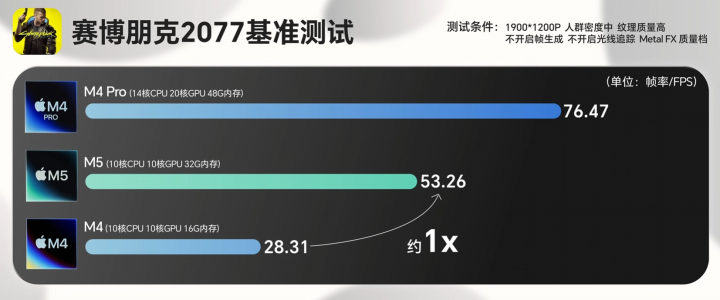
oh my Apple finally has a real GPU uarch.thats very good increase. Metal FX was set to quality, medium crowd density and no RT.
long overdue.
bughammer3 results are also self-evident.
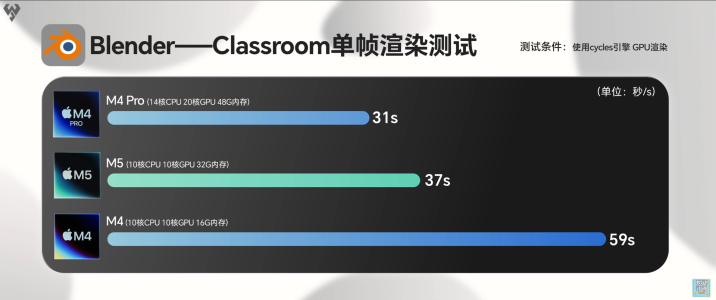
The difference is strikingly small. This is not enough to draw any conclusions, but Apple is really catching up with NV. I would really like someone to do a full review of the capabilities of 3D rendering on Apple Silicon for heavy projects and power consumption during such work, and compare it with other GPUs.
TRENDING THREADS
-
 Discussion Zen 5 Speculation (EPYC Turin and Strix Point/Granite Ridge - Ryzen 9000)
- Started by DisEnchantment
- Replies: 25K
-
Discussion Intel Meteor, Arrow, Lunar & Panther Lakes + WCL Discussion Threads
- Started by Tigerick
- Replies: 25K
-
 Discussion Intel current and future Lakes & Rapids thread
- Started by TheF34RChannel
- Replies: 24K
-

-
