• We’re currently investigating an issue related to the forum theme and styling that is impacting page layout and visual formatting. The problem has been identified, and we are actively working on a resolution. There is no impact to user data or functionality, this is strictly a front-end display issue. We’ll post an update once the fix has been deployed. Thanks for your patience while we get this sorted.

Discussion Qualcomm Snapdragon Thread

Page 199 - Seeking answers? Join the AnandTech community: where nearly half-a-million members share solutions and discuss the latest tech.
Is Bluetooth 7 even a thing? I don’t see any literature on it. Latest revision is 6.2. Though by then it is likely to come out.
WiFi 8 is good for future proofing, but I doubt many people even have a WiFi 7 router.

The only thing I can find it is that is "designed alongside Wifi 8" so maybe they merged the wifi and BT groups and co-developed the two standards?
 
The WiFi 8 chip is pretty interesting... First mobile design using 4x4 radios which should increase throughput noticeably compared to commonplace 2x2 radios.

Who is running into too low of wifi speeds on their phone and needs more? If wifi throughput is low it isn't because it needs more antennas it is because it needs a better router to connect to or you need to be closer to the router / have fewer walls in the way.
 
Who is running into too low of wifi speeds on their phone and needs more? If wifi throughput is low it isn't because it needs more antennas it is because it needs a better router to connect to or you need to be closer to the router / have fewer walls in the way.
It's not necessarily for peak speeds. More chains improve coverage and give you higher speeds under poor conditions. When your phone negotiates a higher data rate, it increase the overall throughput of the network.
 
It's not necessarily for peak speeds. More chains improve coverage and give you higher speeds under poor conditions. When your phone negotiates a higher data rate, it increase the overall throughput of the network.
That’s good and all, but I feel like this is more important for the cellular radio. Normally people aren’t going to be that far from an WiFi access point in their house. But yes better connections on the edge regardless is beneficial.
 
That’s good and all, but I feel like this is more important for the cellular radio. Normally people aren’t going to be that far from an WiFi access point in their house. But yes better connections on the edge regardless is beneficial.
I definitely agree that cellular matters more than WiFi and that WiFi in the home is largely a solved problem. Better WiFi is still important for workplaces, schools, coffee shops, etc.
 
i find it interesting Apple took the opposite approach of Qualcomm.

apple have less Super cores and more Perf coree whereas Qualcomm used for Prime cores and less performance cores.

Apple: 6P+12M
Q: 12P+6M

I bet Apples approach is less power hungry in Cinebench or blender while being more powerful by few percent.
So Apple has 3 tiers of cores now:
Super
Performance
Efficiency

Qualcomm has only 2 right now:
Prime
Performance

Rumours of 8 Elite G6 say it has a 2+3+3 configuration, so they might also be going the Apple route?

Though I question why shoring up nT performance even more is necessary for phones. Other than the benchmark bros, who cares?
 
Last edited:
So Apple has 3 tiers of cores now:
Super
Performance
Efficiency

Qualcomm has only 2 right now:
Prime
Performance

Rumours of 8 Elite G6 say it has a 2+3+3 configuration, so they might also be going the Apple route?
Mediatek already shown the 3 tiers of OoO ARM cores:
- Ultra
- Premium
- Pro.
Heck, even HUAWEI has a 3 tiers of cores too!

So, expecting Qualcomm going that route too.
 
HDUvhxjaoAA0i1y.jpeg
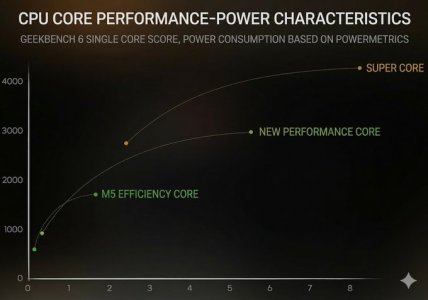
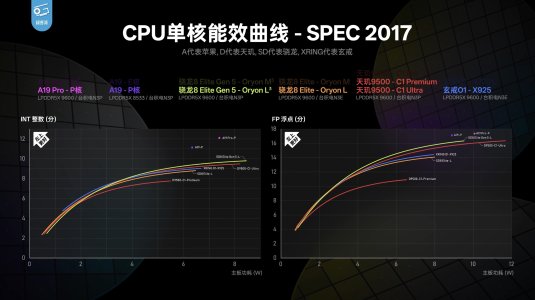
I was curious how Qualcomm's performance cores compared to Apple, so I did some search and the results surprised me.

According to Geekerwan's SPEC2017 numbers, Qualcomm's performance cores have about 2/3 the performance of the prime cores. Assuming that carries over to Geekbench;

Oryon Gen 3Clock speedGeekbench 6
Prime4.6 GHz~3800
Performance3.6 GHz~2500

Comparing that to Apple;

M5 CPUClock SpeedGeekbench 6
Super4.6 GHz~4300
Performance4.4 GHz~3000
Efficiency3 GHz~1700

Apple's performance cores are 20% faster than Qualcomm's. That appears to be thanks to it's ~20% faster clock speed, which means the IPC of both is nearly identical.

Now, the remarkable thing is that Qualcomm's performance core is only 4 wide, compared to Apple's 7 wide.

Takeaway is that the Oryon Performance cores are much stronger than I assumed. Could Qualcomm replicate Apple's strategy with the M5 Pro/M5 Max in a future Snapdragon X CPU? Easily. They already have the hardware in the bag.
 
Last edited:
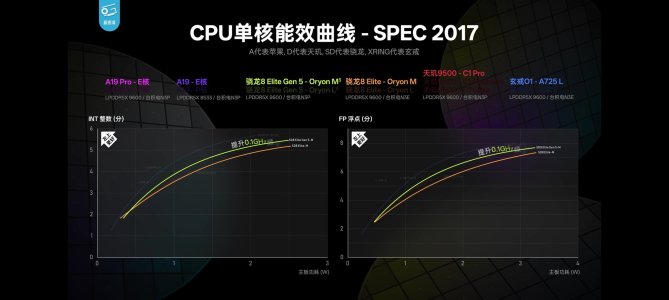
This is interesting. (Source)
G-IIRwhakAAcsyO.jpeg
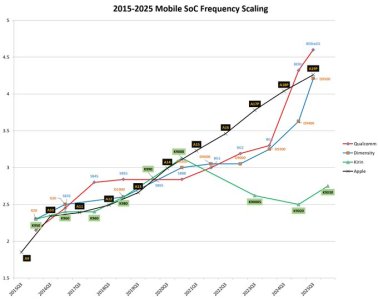
Android phones were stuck at around 3 GHz for a long time, until the huge jump with 8 Elite (Oryon).

We on the cusp of having 5 GHz phones (if the 8E G5) rumours pan out.

Crazy how we went from 3 GHz to 5 GHz in a span of a few years.
 
Last edited:
Wrong link
Fixed.
I'm afraid that what this graph shows is that Apple competitors had to significantly increase frequency to try to reach Axx performance
I see no issue with that. Apple was leading in the first place partly thanks to higher clock speeds, and Qualcomm/ARM had to close that gap.

As it stands 8EG5 is clocked only 10% higher than A19 Pro, and the ST performance is similar. Apple does have a generational IPC and efficiency advantage, though it remains to be seen how this will change next generation.
 
Fixed.

I see no issue with that. Apple was leading in the first place partly thanks to higher clock speeds, and Qualcomm/ARM had to close that gap.

As it stands 8EG5 is clocked only 10% higher than A19 Pro, and the ST performance is similar. Apple does have a generational IPC and efficiency advantage, though it remains to be seen how this will change next generation.
Eh the A19P on average still has a half generation lead in outright single thread performance.
 
Wrong link 🙂


I'm afraid that what this graph shows is that Apple competitors had to significantly increase frequency to try to reach Axx performance.
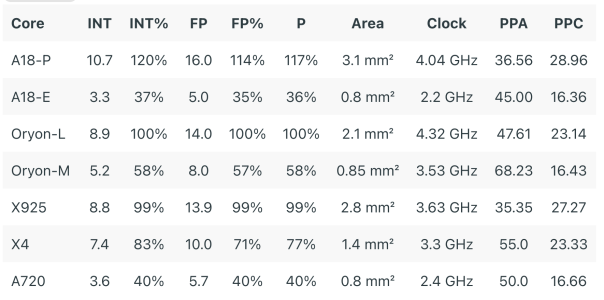
I don't think it's just that. It's a combination of multiple factors:
- Until 2024, Apple's performance cores were really the only ones in their weight class. Arm first introduced the X-series back in 2021, but it wasn't until X925 that they designed a comparable core in terms of execution resources and area constraints. And Qualcomm introduced Phoenix back in 2024.
- Apple were the only ones to use N3B, which saw a big clock speed bump (I think they went from 3.49 to 4.05 in one gen). Everyone else was spoked by the N3 issues and made the jump a year later in 2024 with N3E (X925/Phoenix). As soon as they did that, they made a similar clock speed jump.
1773835799645.png
 
This is interesting. (Source)
View attachment 140242
Android phones were stuck at around 3 GHz for a long time, until the huge jump with 8 Elite (Oryon).

We on the cusp of having 5 GHz phones (if the 8E G5) rumours pan out.

Crazy how we went from 3 GHz to 5 GHz in a span of a few years.
Interesting how Huawei was higher than the rest before, but then comes the ban and LOST a lot of terrain, but is starting to recover the lost ground.

Meanwhile I think where Exynos might be
 
Back
Top