• We’re currently investigating an issue related to the forum theme and styling that is impacting page layout and visual formatting. The problem has been identified, and we are actively working on a resolution. There is no impact to user data or functionality, this is strictly a front-end display issue. We’ll post an update once the fix has been deployed. Thanks for your patience while we get this sorted.

Question AMD Phoenix/Zen 4 APU Speculation and Discussion

Page 32 - Seeking answers? Join the AnandTech community: where nearly half-a-million members share solutions and discuss the latest tech.
I sure hope that +21% in gaming performance against i7-1280P is a lower bound of some sort...
AMD chose the HP Elitebook 840 G9, which actually has DDR5, and compared against their reference system equipped with LPDDR5. Moreover the HP system has 30W PL1/60W PL2 which means it will most likely throttle when pushed because HP isn't known for designing their laptops with the best possible cooling.

They should have compared it against the Lenovo Yoga Slim 9i, as it is one of the few 1280P models equipped with LPDDR5. It has PL2/PL1 of 52/35 W which means it should be possible to have it cooled better. And the results speak for themselves. There is a whopping 36% difference in CB R23 MT scores between the two models.


AMD marketing at it again.
 
They should have compared it against the Lenovo Yoga Slim 9i, as it is one of the few 1280P models equipped with LPDDR5. It has PL2/PL1 of 52/35 W which means it should be possible to have it cooled better. And the results speak for themselves. There is a whopping 36% difference in CB R23 MT scores between the two models.

Sustained scores, the first runs are nearly identical. I couldn't find the slide and endnotes in the slide-deck whether AMD used the 10 minute loop or a single run.
 
AMD chose the HP Elitebook 840 G9, which actually has DDR5, and compared against their reference system equipped with LPDDR5. Moreover the HP system has 30W PL1/60W PL2 which means it will most likely throttle when pushed because HP isn't known for designing their laptops with the best possible cooling.

They should have compared it against the Lenovo Yoga Slim 9i, as it is one of the few 1280P models equipped with LPDDR5. It has PL2/PL1 of 52/35 W which means it should be possible to have it cooled better. And the results speak for themselves. There is a whopping 36% difference in CB R23 MT scores between the two models.


AMD marketing at it again.
I couldn't find the endnotes for that testing. Where did you find which Intel laptop they used?

P.S. All The Watts!! Tweets are no longer accessible for public.
 
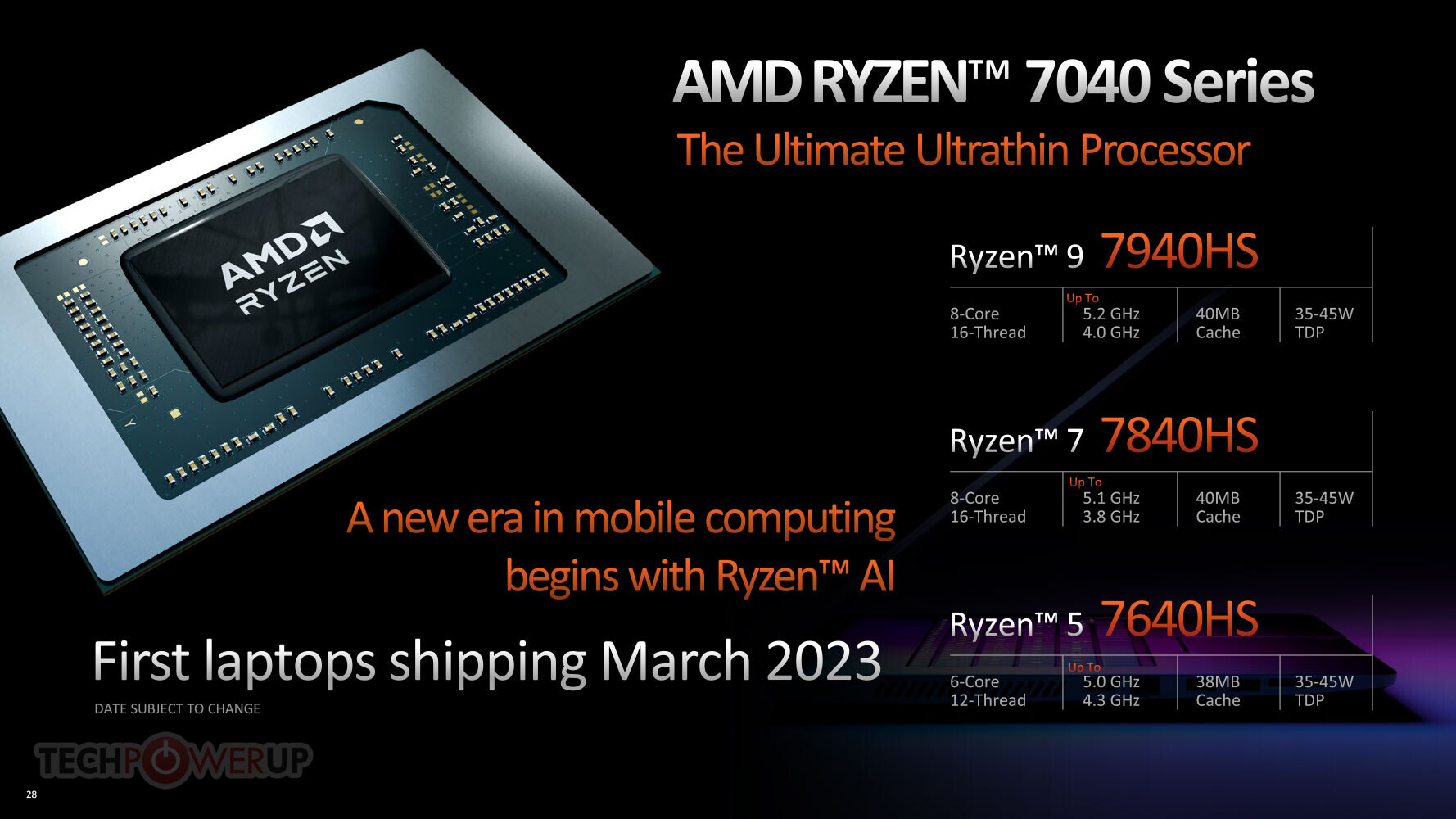
32MB L3 or 16MB L3?

AMD site says 16MB L3 but the slide shows 32MB (+8MB L2).

hnyV1M1dQUi0UtUd.jpg


In any event 3Ghz GPU clocks is a 25% bump vs the 6980HS.
 
What happened to the rumored 16CU-24CU graphics? I wonder why is there no 780M vs 680M comparison from AMD? It could mean the gains are relatively low or not?
 
Eh, it's the same as every other AMD laptop release the hx comes before U.

They have always announced it at the same time though. This makes it sound like if there's going to be Phoenix U parts, it won't be for awhile.

I am getting the impression that Phoenix volume is going to be low.
 
What happened to the rumored 16CU-24CU graphics? I wonder why is there no 780M vs 680M comparison from AMD? It could mean the gains are relatively low or not?

Well 25% increase in clock speed + upto 17% IPC increase could mean quite a large uplift vs the 680M.
 
21% better performance than i7-1280P with 96 EU is pretty meh especially when you count in 25% higher graphics clock speed. 😵
 
Ryan confirmed the L3 cache is 16MB not 32MB as shown on slide....come on, AMD shown some professionalism

Okay. Have we had details on xtor count and die size yet? Trying to see if we can get a bead on Zen 4c here because I would not be surprised if xtor density and layout for Zen4c very closely matches that of the CPU part of Pheonix only doubled.
 
What happened to the rumored 16CU-24CU graphics? I wonder why is there no 780M vs 680M comparison from AMD? It could mean the gains are relatively low or not?

Maybe there's the coast of porting RNDA2 to 4nm, but a killer APU would be one with more RDNA2 CUs than 12 RDNA3 CUs.
RDNA3 feels like a waste of transistors to me.
 
Last edited:
Okay. Have we had details on xtor count and die size yet? Trying to see if we can get a bead on Zen 4c here because I would not be surprised if xtor density and layout for Zen4c very closely matches that of the CPU part of Pheonix only doubled.
die size is 178mm2 with 25B transistors, more than M2, guess AIE eats up lots of it
 
What happened to the rumored 16CU-24CU graphics? I wonder why is there no 780M vs 680M comparison from AMD? It could mean the gains are relatively low or not?
Strix Point, always was.
At ir.amd.com It is 32MB L3.
Link

View attachment 73971

P.S. It's hilarious how they can't even double-check what they write. I saw 16MB on their webpage and a single laptop slide.
21% over competition?

Makes absolutely zero sense.

It would mean that they achieved regression in IPC with PHX.

I mean, REMBRANDT was 60% faster in gaming than 96EU Iris G7.

To what they compare it here? Rembrandt is their closest competition?


I mean, what the hell? Is it another case of AMD's absolutely moronic marketing?
 
They said 250+ designs from the start, this imply big quantities if each design is to break even rapidly enough.

Probably across the entire 7000 mobile product line, which also includes Dragon Range, Rembrandt, Barcelo and Mendocino.
 
  • Like
Reactions: ftt
Strix Point, always was.

21% over competition?

Makes absolutely zero sense.

It would mean that they achieved regression in IPC with PHX.

I mean, REMBRANDT was 60% faster in gaming than 96EU Iris G7.

To what they compare it here? Rembrandt is their closest competition?


I mean, what the hell? Is it another case of AMD's absolutely moronic marketing?

21% mean with a dGPU vs competition rather than the iGPU.

EDIT: Or not according to the notes.
 
Back
Top