
adroc_thurston
Diamond Member
They did it half a year ago.scrap the AT0 flagship GPU for gaming
Never had any after the RV770 suicide.whatever mind share Radeon may still have with consumers.

They did it half a year ago.scrap the AT0 flagship GPU for gaming
Never had any after the RV770 suicide.whatever mind share Radeon may still have with consumers.

People who buy high end GPUs for gaming (like myself) run 4k+ monitors and want to enjoy 4k native 100 FPS+ perf. Only handful of games (UE5 based, CP2027 PT) really require DLSS and usually Quality works just fine: 1440P -> 4K upscaling works fine in FSR too, where DLSS works better is much lower reses, but that's not the situation for high end GPUs.That's another bad assumption. It will sell for more than an RTX 5090 if they caught the customer they hunted. But not to us. There's no way you build a chip that big on the hope to sell it to DLSS enthusiasts.

I see Kepler_L2 disagreeing with you on this and I'm trying to reconcile who has the more current inside knowledge. Because Kepler_L2 says that AMD will still launch the AT0 RDNA 5 flagship GPU for gaming to compete with NVIDIA in high-end gaming GPUs for the next generation. I'm curious to know how you came to your conclusion.They did it half a year ago.
Never had any after the RV770 suicide.
@Kepler_L2 has a solid track record. It's not even close.I see Kepler_L2 disagreeing with you on this and I'm trying to reconcile who has the more current inside knowledge.
It's open season for press grilling:

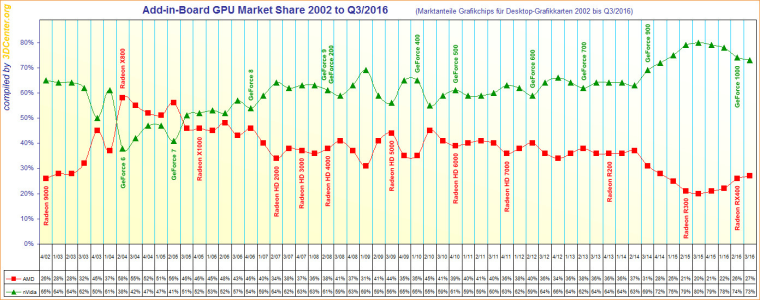
PC graphics cards are now nearly 100 percent Nvidia
The latest analysis of the PC graphics-card market shows AMD following Intel's plunge in market share, ceding almost the entire PC graphics market to Nvidia.www.pcworld.com

it will launch but probably a prosumer version for dual use as AI & Gaming, just like Radeon VIII see Kepler_L2 disagreeing with you on this and I'm trying to reconcile who has the more current inside knowledge. Because Kepler_L2 says that AMD will still launch the AT0 RDNA 5 flagship GPU for gaming to compete with NVIDIA in high-end gaming GPUs for the next generation. I'm curious to know how you came to your conclusion.
it will launch but probably a prosumer version for dual use as AI & Gaming, just like Radeon VII
So it won't compete directly with nvidia — in gaming
The die is alive and well. Client product is dead.I see Kepler_L2 disagreeing with you on this and I'm trying to reconcile who has the more current inside knowledge. Because Kepler_L2 says that AMD will still launch the AT0 RDNA 5 flagship GPU for gaming to compete with NVIDIA in high-end gaming GPUs for the next generation. I'm curious to know how you came to your conclusion.
I too love loss leaders.That was 18 years ago and AMD kept their dGPU marketshare above 30% for another 7 years and 4 new architectures after RV770's release.
6090 is a client part, and no, AMD isn't trying to compete with NV anymore.If desktop AT0 competes in performance against the 6090 then it competes directly with nvidia in gaming, as the 6090 like the other x090/Titan cards should be a prosumer option.
The Radeon VII couldn't be a prosumer card in the same range as the Titan RTX because it was neither large/wide enough (less transistors than the RTX 2080 TU104) nor was it performant enough (it lagged in performance against the RTX 2080 despite using brand new 7nm from TSMC).
Nah.The die is alive and well. Client product is dead.
Wow, we must be really thankful to AMD for 18 years of pure charity towards us PC gamers.I too love loss leaders.
RV770 made Radeon a poverty brand, a place from which there was no return. RIP.
Yup.
Indeed.Wow, we must be really thankful to AMD for 18 years of pure charity towards us PC gamers.
Why pointless - these teams now make GPUs that will now earn AMD more than CPUs over it's entire company history.it was 11 years of pointless cash burn instead.
You know you can run IP roadmap without torching pallets of cash on dumb client graphics misadventures?Why pointless - these teams now make GPUs that will now earn AMD more than CPUs over it's entire company history.
As an RTX 5090 owner, it is 100% a consumer gaming GPU. Especially when you play games at 4K with Path Tracing enabled and you are still needing DLSS Quality Mode to get over 60FPS with max settings on games like Cyberpunk 2077. The only GPU that you could call "prosumer" would be the RTX PRO 6000. So, if AMD is going to use the RDNA 5 AT0 flagship GPU to compete against the equivalent of the RTX PRO 6000, then I would say the AT0 is a "client only" or enterprise only GPU; otherwise, it will 100% still be in the running as a high-end gaming GPU just like the NVIDIA xx90 models are.If desktop AT0 competes in performance against the 6090 then it competes directly with nvidia in gaming, as the 6090 like the other x090/Titan cards should be a prosumer option.
It's a cloud VDI part.As an RTX 5090 owner, it is 100% a consumer gaming GPU. Especially when you play games at 4K with Path Tracing enabled and you are still needing DLSS Quality Mode to get over 60FPS with max settings on games like Cyberpunk 2077. The only GPU that you could call "prosumer" would be the RTX PRO 6000. So, if AMD is going to use the RDNA 5 AT0 flagship GPU to compete against the equivalent of the RTX PRO 6000, then I would say the AT0 is a "client only" or enterprise only GPU; otherwise, it will 100% still be in the running as a high-end gaming GPU just like the NVIDIA xx90 models are.
Oh really? That's interesting. So, AMD is going to use the AT0 for Virtual Desktop Infrastructure for enterprise rather than a discrete GPU for your general consumer? I guess that makes sense.It's a cloud VDI part.
As an RTX 5090 owner, it is 100% a consumer gaming GPU. Especially when you play games at 4K with Path Tracing enabled and you are still needing DLSS Quality Mode to get over 60FPS with max settings on games like Cyberpunk 2077. The only GPU that you could call "prosumer" would be the RTX PRO 6000. So, if AMD is going to use the RDNA 5 AT0 flagship GPU to compete against the equivalent of the RTX PRO 6000, then I would say the AT0 is a "client only" or enterprise only GPU; otherwise, it will 100% still be in the running as a high-end gaming GPU just like the NVIDIA xx90 models are.
Nah. Consumer part isn't cancelled. Repeating it more doesn't make it real.It's a cloud VDI part.
Unless AT0 is cancelled entirely it will 100% release to consumers, even if it's a token release with no real volume like the Radeon VII.

AT0 seems more like a GPU designed for the iterative upgrade of XCloud.Oh really? That's interesting. So, AMD is going to use the AT0 for Virtual Desktop Infrastructure for enterprise rather than a discrete GPU for your general consumer? I guess that makes sense.
not AMD. Microsoft. the contracts are signed & its a done dealOh really? That's interesting. So, AMD is going to use the AT0 for Virtual Desktop Infrastructure for enterprise rather than a discrete GPU for your general consumer? I guess that makes sense.
Yeah.So, AMD is going to use the AT0 for Virtual Desktop Infrastructure for enterprise rather than a discrete GPU for your general consumer?
Bruddah the bulk of AMD VDI is at AWS.AMD. Microsoft. the contracts are signed & its a done deal
It is dead.Consumer part isn't cancelled
I mean...yeah. Duh!Nah you just want AT0 to exist to exist in the consumer space, just so that you could buy 6090 for cheaper
No, you can't run a credible IP roadmap without people actually shipping silicon and learning from their mistakes, and you certainly can't do it for over a decade with zero revenues. AMD lost to Nvidia because their main business was self-bulldozered, only maybe in last 5-6 years they finally had the money to improve GPU side of things, and sadly they underinvested.You know you can run IP roadmap without torching pallets of cash on dumb client graphics misadventures?
Why do you think people who can afford to buy 5090 won't be able to do so with 6090? I am on 4090 but only because I refuse to upgrade to only 30%+ above my current card, when 4090 came out I bought it straight as upgrade to 3090, and before that I was on Titan: double perf gets my money, so if AMD releases AT0 and it is 30%+ above 5090 then this should be enough for me to upgrade, not least because RDNA5 seems to have exciting list of tech that will last for a bit, and being used in PS6 it will make ports better (unless Sony stops them, which sure looks that way now).Nah you just want AT0 to exist to exist in the consumer space, just so that you could buy 6090 for cheaper
It's a cloud VDI part.
Yes you can and no you don't need loss leader parts for that.No, you can't run a credible IP roadmap without people actually shipping silicon and learning from their mistakes, and you certainly can't do it for over a decade with zero revenues
They're about to.And Zen5 is a server chip, so what - stop selling consumer chips
They might for Zen 6, for reasons that you know very well - crazy server chip demand _and_ it's on N2 which is also used for high margin MI45x, but will they stop selling consumer Zen5 and reset market share to 0?They're about to.
No, that's can't be done in a PLC in current times (or 10 years ago).Yes you can and no you don't need loss leader parts for that.


