
-
We’re currently investigating an issue related to the forum theme and styling that is impacting page layout and visual formatting. The problem has been identified, and we are actively working on a resolution. There is no impact to user data or functionality, this is strictly a front-end display issue. We’ll post an update once the fix has been deployed. Thanks for your patience while we get this sorted.
You are using an out of date browser. It may not display this or other websites correctly.
You should upgrade or use an alternative browser.
You should upgrade or use an alternative browser.
Discussion RDNA 5 / UDNA (CDNA Next) speculation
Page 119 - Seeking answers? Join the AnandTech community: where nearly half-a-million members share solutions and discuss the latest tech.

gdansk
Diamond Member
Haven't they already made enough announcements regarding HBMDo you think companies like AMD will make any announcements regarding HBM

1250
Member
Customized for LPDDR functionalityHaven't they already made enough announcements regarding HBM

adroc_thurston
Diamond Member
Yes it's a base die.Customized for LPDDR functionality
Yes it's on SF4X.
Yes it has LPDDR shoreline.
Yes AMD has tapped SF2P/X PDKs.
Any questions?
1250
Member
Did co-development play such a pivotal role in sam's transition to 4nm?Any questions?
(They probably don't even consider it co-development)
Those in the memory guy usually dismiss its impact, treating it like a trivial late-stage addition.
(They probably think so) I owe you
Last edited:
Tangopiper
Member
Anything actually planned for SF2P/X?Yes it's a base die.
Yes it's on SF4X.
Yes it has LPDDR shoreline.
Yes AMD has tapped SF2P/X PDKs.
Any questions?
adroc_thurston
Diamond Member
No.Did co-development play such a pivotal role in sam성's transition to 4nm?
Memory is a commodity, thus their opinions are irrelevant.Those in the memory guy usually dismiss its impact, treating it like a trivial late-stage addition.
Dunno.Anything actually planned for SF2P/X?
But they tickle the PDK.
adroc_thurston
Diamond Member
Does it matter? They say and DRAM slaves obey.What is the estimated share of AMD's contribution to this joint development? 10%?
1250
Member
yeah~ I'm just curious if AMD's IPs, such as Infinity Fabric (IF), were integrated into it.Does it matter? They say and DRAM slaves obey.
this final-last question sorry As You Know I'm still a bit of a newbie when it comes to the details
Last edited:
adroc_thurston
Diamond Member
Obviously, that's the whole point of a custom base die.I'm just curious if AMD's IPs, such as Infinity Fabric (IF), were integrated into it.
Customer IP goes there!
1250
Member
Left to themselves, they’ll probably reach a point where they deny it's even 'Custom'. thanks, sirObviously, that's the whole point of a custom base die.
Customer IP goes there!
What's the advantage of that vs a standard stack. Where does the benefit come from?Obviously, that's the whole point of a custom base die.
Customer IP goes there!
adroc_thurston
Diamond Member
You get to pick your base die process node, and again, you put your IP there.What's the advantage of that vs a standard stack. Where does the benefit come from?
Consider it a miniature version of MI400's own AID.
Tangopiper
Member
They've been tickling SF PDKs for years. It's why we keep getting rumours of Samsung-made APUs etc.But they tickle the PDK.
Funny that they are actually using SF4 family for this custom HBM base die but nothing about that ever reached the rumour mill lol.
I supppose there was Sonoma Valley before it got axed.
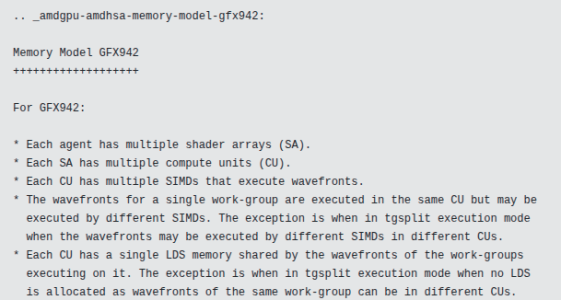
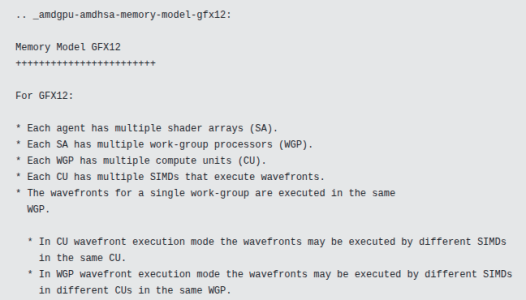
Why do you think that the 18000 Compute Units are CUs?I understand that CDNA 4 and 5 have the same apparent CU count,
See llvm/docs/AMDGPUUsage.rst
GFX942:
GFX12
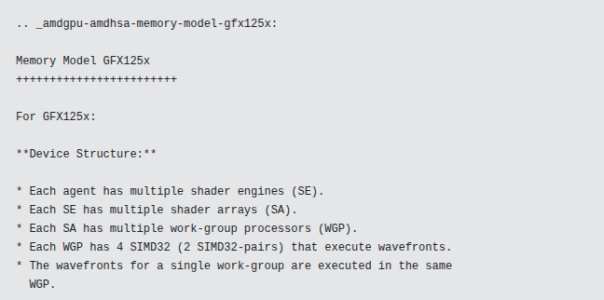
GFX125x
Same! 🤣lol I could be in a random meeting and anytime someone says anything that sounds close to SMT I always think of this forum and SMT4...
Then I get weird looks because i'm smiling to myself.
Huh, so GFX125x has only 128 ALUs per WGP?
Interesting.
I guess GFX130x/131x WGPs will still have 256 ALUs though, otherwise the RDNA5 VOPD improvements would be kind of pointless, unless I'm missing something.
It's also interesting that the SEs are no longer equivalent to the "agents", like they were in previous gens.
Looks like AMD introduced another control layer above SEs. I wonder if that's more about utilization, or about flexibility.
My first thought was it might've been about chiplets, but GFX94x already had chiplets too, so I guess not.
No, it's 256 ALUs for most vector ops.Huh, so GFX125x has only 128 ALUs per WGP?
Interesting.
I guess GFX130x/131x WGPs will still have 256 ALUs though, otherwise the RDNA5 VOPD improvements would be kind of pointless, unless I'm missing something.
It's also interesting that the SEs are no longer equivalent to the "agents", like they were in previous gens.
Looks like AMD introduced another control layer above SEs. I wonder if that's more about utilization, or about flexibility.
My first thought was it might've been about chiplets, but GFX94x already had chiplets too, so I guess not.
He checked and says there's no LPDDR. What should I do about this?
Tell him to check again after he actually wakes up?
That was a dumb "rumor" anyway.
TRENDING THREADS
-
 Discussion Zen 5 Speculation (EPYC Turin and Strix Point/Granite Ridge - Ryzen 9000)
- Started by DisEnchantment
- Replies: 25K
-
Discussion Intel Meteor, Arrow, Lunar & Panther Lakes + WCL Discussion Threads
- Started by Tigerick
- Replies: 25K
-
 Discussion Intel current and future Lakes & Rapids thread
- Started by TheF34RChannel
- Replies: 24K
-

-
