• We’re currently investigating an issue related to the forum theme and styling that is impacting page layout and visual formatting. The problem has been identified, and we are actively working on a resolution. There is no impact to user data or functionality, this is strictly a front-end display issue. We’ll post an update once the fix has been deployed. Thanks for your patience while we get this sorted.

Discussion Apple Silicon SoC thread

Page 481 - Seeking answers? Join the AnandTech community: where nearly half-a-million members share solutions and discuss the latest tech.

Eug

Lifer
M1
5 nm
Unified memory architecture - LP-DDR4
16 billion transistors

8-core CPU

4 high-performance cores
192 KB instruction cache
128 KB data cache
Shared 12 MB L2 cache

4 high-efficiency cores
128 KB instruction cache
64 KB data cache
Shared 4 MB L2 cache
(Apple claims the 4 high-effiency cores alone perform like a dual-core Intel MacBook Air)

8-core iGPU (but there is a 7-core variant, likely with one inactive core)
128 execution units
Up to 24576 concurrent threads
2.6 Teraflops
82 Gigatexels/s
41 gigapixels/s

16-core neural engine
Secure Enclave
USB 4

Products:
$999 ($899 edu) 13" MacBook Air (fanless) - 18 hour video playback battery life
$699 Mac mini (with fan)
$1299 ($1199 edu) 13" MacBook Pro (with fan) - 20 hour video playback battery life

Memory options 8 GB and 16 GB. No 32 GB option (unless you go Intel).

It should be noted that the M1 chip in these three Macs is the same (aside from GPU core number). Basically, Apple is taking the same approach which these chips as they do the iPhones and iPads. Just one SKU (excluding the X variants), which is the same across all iDevices (aside from maybe slight clock speed differences occasionally).

EDIT:

Screen-Shot-2021-10-18-at-1.20.47-PM.jpg

M1 Pro 8-core CPU (6+2), 14-core GPU
M1 Pro 10-core CPU (8+2), 14-core GPU
M1 Pro 10-core CPU (8+2), 16-core GPU
M1 Max 10-core CPU (8+2), 24-core GPU
M1 Max 10-core CPU (8+2), 32-core GPU

M1 Pro and M1 Max discussion here:


M1 Ultra discussion here:


M2 discussion here:


Second Generation 5 nm
Unified memory architecture - LPDDR5, up to 24 GB and 100 GB/s
20 billion transistors

8-core CPU

4 high-performance cores
192 KB instruction cache
128 KB data cache
Shared 16 MB L2 cache

4 high-efficiency cores
128 KB instruction cache
64 KB data cache
Shared 4 MB L2 cache

10-core iGPU (but there is an 8-core variant)
3.6 Teraflops

16-core neural engine
Secure Enclave
USB 4

Hardware acceleration for 8K h.264, h.264, ProRes

M3 Family discussion here:


M4 Family discussion here:


M5 Family discussion here:

 
Last edited:
People moving away from Chrome fixes the problem that Chrome's popularity has created. Websites won't be able to use non-standard HTML that breaks on non-Chrome browsers. It's not as bad as the old days with ActiveX and IE6, but there's no reason to stray any closer to that horrible time either.

Yes this.

If Apple was ever forced to fully support third party browsers on iOS (i.e. "real" Chrome rather than making it a wrapper using Safari's Webkit engine) we would quickly return to the dark days of "best viewed on IE6" badges on websites.

Web devs didn't want to build/test their websites on anything other than IE6, so things were pretty bad for Netscape/Firefox for a few years.

The same thing would happen if Apple was forced to allow full Chrome on iOS, they'd support only that and not only Safari users but Firefox users would suffer. With a monopoly in place then Google could do all the things they are slowly moving towards but competition prevents them from doing, like dropping all extensions (so no more ad blocking) and requiring support for all the really insecure capabilities like giving the browser direct access to USB and other system devices on your system, in the name of making "webapps" with the full capability of mobile apps or PC applications.

Recently there was a CVE for a bug discovered on Safari that was part of a one of those long exploit chains. It turned out that bug had been present for a LONG time. How long you ask? So long that the bug was also present in Chrome, because it was present in Webkit before Google forked it. So that same bug was ALSO present in Chrome and Edge, and every other Chromium browser. Only Firefox and other non Chrome/Webkit based browsers were immune.

That's the risk a browser monoculture presents, though this is a rather extreme example since it dates back to before Google's fork. But if you effectively make it so Chrome is all there (Firefox would cease to exist if webdevs could design and test for Chrome only) is then exploits that affect literally every web user (for all practical purposes) will be the result.

So it is in everyone's interest to avoid Chrome on Apple platforms at least, if not elsewhere.
 
So, a performance result that I don't think obviously derives from existing benchmarks.

Many/all of the video editing apps - FCP/Resolve, etc have fairly substantial support for AI filter/effects and/or existing filter/effects reimplemented from a conventional CPU to GPU/AI which usually benefit greatly from the matmul acceleration in the GPU, so these fairly slow tasks are getting 2x-4x boosts from M4 Pro/Max to M5 Pro/Max. Video/audio editing are basically the main use cases for the M5 Max, so it's not some small subset of that market.

This may become a bit of a forward problem for Apple with some of these models that seem quite clearly tailored to particular types of work. If you're just dicking around and want something fast, then the benchmarks will be fine, but if you're doing FCP work, Apple again has the ability to codesign that whole use case if it's a big enough market for them.
 
You never have to check if Chrome is supported for any website.
I've never had to check if Safari is supported for a website. I only did that because I had a hard time believing that the Canadian government had an inoperable website on the phones of ⅔ of their citizens. Seems like the kind of thing they'd get a phone call over. Well, maybe not, y'all really nice up there.

Now the US website - I'm shocked we haven't yet turned it over to a Russian firm that promised to 'do great security cheap, Putin like much' in an unsolicited Signal chat to one our our Ivy League WH grads.
 
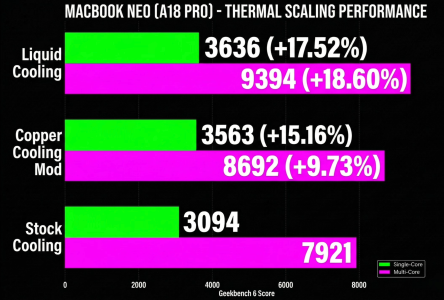
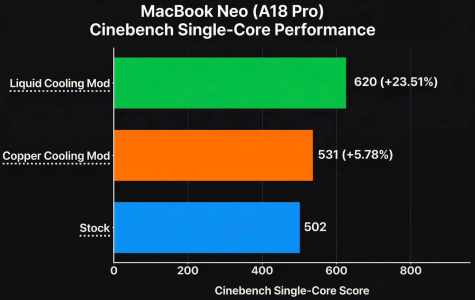
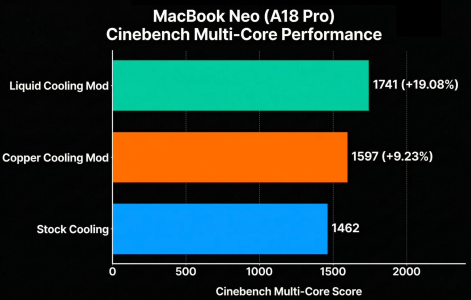
Adding a copper heatsink plate and external active cooling to the MacBook Neo increases in-game real-time FPS from ~32 fps (with SoC temp at 105 C) to ~86 fps (with much lower SoC temp).

Basically he cut a thin sheet of copper plate and put it over the SoC with some thermal paste, and then put a thermal pad over the copper plate so that it comes in contact with the chassis. That is the copper mod below. Then he added a removable liquid phone cooler on the external surface of the chassis, and that's the liquid cooling mod below.

Screenshot 2026-03-25 at 4.50.47 PM.png

Screenshot 2026-03-25 at 4.51.22 PM.png

Screenshot 2026-03-25 at 4.51.05 PM.png

 
So, while cooling does help performance, it's only just slightly better than an M4 in ST geekbench 6, but gets smoked in MT, and the M4 Air has twice the RAM. I'd rather get a refurb M4 air...
 
Adding a copper heatsink plate and external active cooling to the MacBook Neo increases in-game real-time FPS from ~32 fps (with SoC temp at 105 C) to ~86 fps (with much lower SoC temp).

Basically he cut a thin sheet of copper plate and put it over the SoC with some thermal paste, and then put a thermal pad over the copper plate so that it comes in contact with the chassis. That is the copper mod below. Then he added a removable liquid phone cooler on the external surface of the chassis, and that's the liquid cooling mod below.

View attachment 140696
Is there any explanation why their 'stock cooling' score is much lower than all other tests available online? Is this from a 10 minute loop or something?
 
So, while cooling does help performance, it's only just slightly better than an M4 in ST geekbench 6, but gets smoked in MT, and the M4 Air has twice the RAM. I'd rather get a refurb M4 air...
M4 is superior in Geekbench than the A18 Pro in ST, about 3850 to 3550. What is typical is the A-pro is similar in ST performance to the previous years M-series.

What is interesting to me is the Speedometer 3.1 scores. In Safari my 16PM scores in the 37s, and my M4 Mini scores in the 47s. In that review he is showing the M3 at 50! And the A18 Pro at 50 too. Idk weird.

And adding to the weirdness is my M4 in CB 2024 and 2026 scores higher than the M4 listed there in ST. In nT it’s not even close.
 
M4 is superior in Geekbench than the A18 Pro in ST, about 3850 to 3550. What is typical is the A-pro is similar in ST performance to the previous years M-series.

What is interesting to me is the Speedometer 3.1 scores. In Safari my 16PM scores in the 37s, and my M4 Mini scores in the 47s. In that review he is showing the M3 at 50! And the A18 Pro at 50 too. Idk weird.

And adding to the weirdness is my M4 in CB 2024 and 2026 scores higher than the M4 listed there in ST. In nT it’s not even close.
M4 Air has passive cooling, m4 mini has a fan. I think you’re just seeing the consequence of thermal throttling behavior.
 
Is there any explanation why their 'stock cooling' score is much lower than all other tests available online? Is this from a 10 minute loop or something?
Not sure because IIRC this wasn’t explained in the video. However, it was implied that most of the testing was after the machine was already warm. Like for instance, the gaming fps at 32 fps would have been after throttling had kicked in, not at first launch.
 
So, while cooling does help performance, it's only just slightly better than an M4 in ST geekbench 6, but gets smoked in MT, and the M4 Air has twice the RAM. I'd rather get a refurb M4 air...

For some people that extra $160 you'll pay for the M4 refurb matters.

Buying a bunch of refurbs is probably not an option if you're ordering in bulk like a school or business, but as an individual if you value the extra MT and RAM more than the $160 you'd save, sure.
 
Or if you were one who bought the NIB $750 M4 MBA13s last November.
But the Neo exists (partly) to allow Apple to stop retailers offering such a deal.
 
Except that unlike IE6 it isn't being moved to maintenance tier and keeps adding new features directly to the working standard. It's the evergreen IE6 from the company that also runs the working group documents. The weakness of IE6 was that it was outdated a few years later and non-standard. Without those two complaints, what's the problem?

Mind you I use Firefox so I have no horse in this race. It's pretty much a lost cause and complaining that people should stop using Chrome to enjoy their normal-user chasing laptop is a bit of a joke.
Safari is the modern IE6, yes. lol.
 
Half the market for the Neo is institutions.
Yep.

And the other half is people who don't read benchmarks.
Yep again, although sometimes some in this group irritate me. They ask for advice about what to buy, and then much of the time choose to ignore the advice. Then they complain when it doesn't always behave quite like how some clickbait YouTuber claimed it would.
 
Geekerwan has come back to life
One of the best and most balanced reviews I've seen so far. And it's sad but funny half the comment section is saying they're happy he's still alive. 😱

He's basically saying it's a very well built package for basic Mac users and for non-Mac users serves as a very good intro to macOS, albeit with some caveats, the most important of which is RAM.

It's a nice machine with best in class trackpad, accurate screen colour calibration, decent performance for everyday type stuff, and decent battery life, although the battery life is somewhat worse than other Mac laptops, the charging is slow, and the second USB-C port being USB 2 is a downer.

8 GB on this Mac does way better than 8 GB Windows machines, but it's still holding the hardware back. With some programs in the background and a bunch of browser tabs, it starts to lag, and this time the testing was with Safari, not Chrome. The lagginess appears to be strictly due to the 8 GB memory and swap and not the CPU, even though the CPU will throttle quickly with any heavy load. Although not a deal killer for most in this price class, the lagginess while multitasking is still noticeable nonetheless. As an intro machine for a new Mac users, it's fine, but once somebody gets used to macOS, they may decide they'd want to get something higher end. OTOH, if they decide not stay with macOS, the Neo will probably have good resale value.
 
Oh wow. That's probably the fastest BMC in the world.
All the ones I've used are slow as hell so those Apple DC people are very lucky.
 
Back
Top