• We’re currently investigating an issue related to the forum theme and styling that is impacting page layout and visual formatting. The problem has been identified, and we are actively working on a resolution. There is no impact to user data or functionality, this is strictly a front-end display issue. We’ll post an update once the fix has been deployed. Thanks for your patience while we get this sorted.

Discussion Apple Silicon SoC thread

Page 459 - Seeking answers? Join the AnandTech community: where nearly half-a-million members share solutions and discuss the latest tech.

Eug

Lifer
M1
5 nm
Unified memory architecture - LP-DDR4
16 billion transistors

8-core CPU

4 high-performance cores
192 KB instruction cache
128 KB data cache
Shared 12 MB L2 cache

4 high-efficiency cores
128 KB instruction cache
64 KB data cache
Shared 4 MB L2 cache
(Apple claims the 4 high-effiency cores alone perform like a dual-core Intel MacBook Air)

8-core iGPU (but there is a 7-core variant, likely with one inactive core)
128 execution units
Up to 24576 concurrent threads
2.6 Teraflops
82 Gigatexels/s
41 gigapixels/s

16-core neural engine
Secure Enclave
USB 4

Products:
$999 ($899 edu) 13" MacBook Air (fanless) - 18 hour video playback battery life
$699 Mac mini (with fan)
$1299 ($1199 edu) 13" MacBook Pro (with fan) - 20 hour video playback battery life

Memory options 8 GB and 16 GB. No 32 GB option (unless you go Intel).

It should be noted that the M1 chip in these three Macs is the same (aside from GPU core number). Basically, Apple is taking the same approach which these chips as they do the iPhones and iPads. Just one SKU (excluding the X variants), which is the same across all iDevices (aside from maybe slight clock speed differences occasionally).

EDIT:

Screen-Shot-2021-10-18-at-1.20.47-PM.jpg

M1 Pro 8-core CPU (6+2), 14-core GPU
M1 Pro 10-core CPU (8+2), 14-core GPU
M1 Pro 10-core CPU (8+2), 16-core GPU
M1 Max 10-core CPU (8+2), 24-core GPU
M1 Max 10-core CPU (8+2), 32-core GPU

M1 Pro and M1 Max discussion here:


M1 Ultra discussion here:


M2 discussion here:


Second Generation 5 nm
Unified memory architecture - LPDDR5, up to 24 GB and 100 GB/s
20 billion transistors

8-core CPU

4 high-performance cores
192 KB instruction cache
128 KB data cache
Shared 16 MB L2 cache

4 high-efficiency cores
128 KB instruction cache
64 KB data cache
Shared 4 MB L2 cache

10-core iGPU (but there is an 8-core variant)
3.6 Teraflops

16-core neural engine
Secure Enclave
USB 4

Hardware acceleration for 8K h.264, h.264, ProRes

M3 Family discussion here:


M4 Family discussion here:


M5 Family discussion here:

 
Last edited:
I bet that the A19 or A19 Pro for monitors is binned. Many parts in these SoCs may be defective, but there are enough working parts to handle the functionality for future monitors.

Yeah it would be interesting to see a teardown and see how many memory channels it is using for example. It could easily get by with a 32 bit bus, but losing a memory controller or two would be fatal for using it in an iPhone. Could get by with a lost P and multiple E cores, lose half an L2, probably doesn't use NPU at all, etc. etc.

There might also be parts that fail parametric yield and won't make the single clock/power bin to qualify for an iPhone. They can clock at it at reduced frequency, it'll still have more than enough horsepower for what little it is being tasked with.

And saying it will be using A19 doesn't mean that's all it will be using. Its possible they might use more than one generation's worth of reject SoCs. Maybe it starts out using A19 rejects, but down the road is manufactured with A20 rejects.
 
And saying it will be using A19 doesn't mean that's all it will be using. Its possible they might use more than one generation's worth of reject SoCs. Maybe it starts out using A19 rejects, but down the road is manufactured with A20 rejects.
AFAIK, the current Studio Display has never used anything but A13.
 
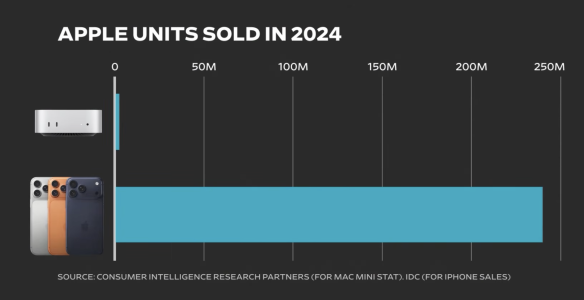
Apparently just domestic/North American Minis, not all of them. iPhone is now India's largest export.
Yeah maybe it’s a harbinger of future moves for onshoring assembly of other products, maybe the Mac Studio next? Would make sense as it’s just a bigger platform Mini.
 
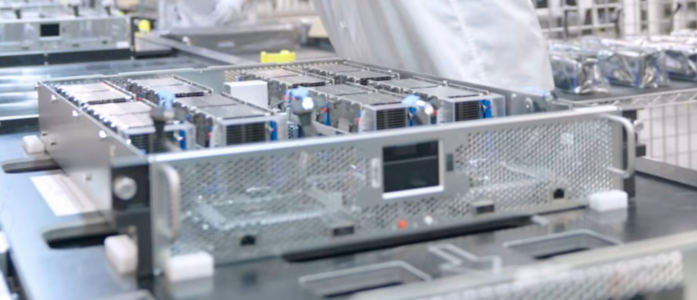
To my eyes those "server" enclosures look a lot more dense than one usually sees.
Look at around 7:20

The most recent sort of relevant images I can find are something like what you see here:

The Apple design, to the extent one can pick up anything from a rapid video, looks to be very different, more like
- the actual "server", the thing that would be a motherboard in a traditional model, is the size and shape of a mac studio (probably is mac studio guts?) wrapped in a thin metal jacket, then
- eight of those are mounted along with power etc on what would normally be a large motherboard

There's an Apple patent here (2020) https://patents.google.com/patent/US12016123B2 High-capacity computer modules, which seems to describe this sort of thing (though that patent being from 5 yrs ago, the details as of the 2026 implementation are doubtless somewhat different).

This looks like its substantially more dense than a traditional server, but I think we have a difficult apples to oranges comparison. If we assume each brick holds say an M5 Ultra, so we're talking 24 P-cores, so a total of 192 P-cores. That's apparently of order, say EPYC 9965 (192 Zen 5c cores) and a motherboard could have two of these mounted.
On the other hand the Apple P-cores are a lot more powerful per core (and have substantially more memory bandwidth).
On the third hand, the Apple design also has, for better or worse, associated with each CPU some pretty powerful GPU which is not, like in a traditional design, disaggregated.

It's impossible for me (and I assume very hard for anyone even inside the business) to know which is "better". The Apple design *looks* like it's physically denser, and it's likely more power efficient. Is it cheaper (for Apple!) than a warehouse full of say Graviton+Trainium is for AMZ? Does it provide better performance per watt than nVidia for training (is Apple even doing that?) or inference?

For people familiar with data center design, another, more recent patent you might want to look at is (2025) https://patents.google.com/patent/US20250377933A1 Systems and methods for managing operations of multiple computing systems.
(Being a pretty recent patent, the google version doesn't have diagrams. To see those you have to go to the awful official US gov site. Being designed by insane people, this doesn't support newfangled technology like "links", so you have to go to
type in
US20250377933A1
wait for it to bring up a page saying "I couldn't find it"
hit the button that says "Take me to Patent Public Search"
then hit the "camera/text" button in the "Document Viewer" tab in the super cool Windows 95 web emulator.

You think I am joking? Every step is exactly like I described.
Oh, and cool bonus feature - the window will auto close after fifteen minutes! Your best strategy is to print the page to PDF and open it in Preview, at least that will hang around.)

This patent shows a board (Fig 2) very similar to what we see in the diagrams but clarifies that the long "brick" holds both the compute board (the "mac studio motherboard") and a "card". The patent, as is usual for these things, tries to make the "card" as general as possible, but I *think* the reality here is that it's a network card, using active copper (plenty of retimers in the design) to provide (TB5? speed) connectivity to a per-motherboard (so per-8 bricks) network switch.
The bulk of the patent is about how you control a rack of these things. The traditional server scheme involves a BMC (board management controller), a small hopefully ultra-reliable microcontroller on the board that's network accessible and that can be used to boot the board, reboot it, if necessary power-cycle if the OS crashes, etc. But Apple have, for example, rather different booting procedures from PCs, and don't ship with a BMC. So the patent is about how to get that functionality (and related matters, like submitting jobs) without a traditional BMC.
 
To my eyes those "server" enclosures look a lot more dense than one usually sees.
Look at around 7:20

The most recent sort of relevant images I can find are something like what you see here:

The Apple design, to the extent one can pick up anything from a rapid video, looks to be very different, more like
- the actual "server", the thing that would be a motherboard in a traditional model, is the size and shape of a mac studio (probably is mac studio guts?) wrapped in a thin metal jacket, then
- eight of those are mounted along with power etc on what would normally be a large motherboard

There's an Apple patent here (2020) https://patents.google.com/patent/US12016123B2 High-capacity computer modules, which seems to describe this sort of thing (though that patent being from 5 yrs ago, the details as of the 2026 implementation are doubtless somewhat different).

This looks like its substantially more dense than a traditional server, but I think we have a difficult apples to oranges comparison. If we assume each brick holds say an M5 Ultra, so we're talking 24 P-cores, so a total of 192 P-cores. That's apparently of order, say EPYC 9965 (192 Zen 5c cores) and a motherboard could have two of these mounted.
On the other hand the Apple P-cores are a lot more powerful per core (and have substantially more memory bandwidth).
On the third hand, the Apple design also has, for better or worse, associated with each CPU some pretty powerful GPU which is not, like in a traditional design, disaggregated.

It's impossible for me (and I assume very hard for anyone even inside the business) to know which is "better". The Apple design *looks* like it's physically denser, and it's likely more power efficient. Is it cheaper (for Apple!) than a warehouse full of say Graviton+Trainium is for AMZ? Does it provide better performance per watt than nVidia for training (is Apple even doing that?) or inference?

For people familiar with data center design, another, more recent patent you might want to look at is (2025) https://patents.google.com/patent/US20250377933A1 Systems and methods for managing operations of multiple computing systems.
(Being a pretty recent patent, the google version doesn't have diagrams. To see those you have to go to the awful official US gov site. Being designed by insane people, this doesn't support newfangled technology like "links", so you have to go to
type in
US20250377933A1
wait for it to bring up a page saying "I couldn't find it"
hit the button that says "Take me to Patent Public Search"
then hit the "camera/text" button in the "Document Viewer" tab in the super cool Windows 95 web emulator.

You think I am joking? Every step is exactly like I described.
Oh, and cool bonus feature - the window will auto close after fifteen minutes! Your best strategy is to print the page to PDF and open it in Preview, at least that will hang around.)

This patent shows a board (Fig 2) very similar to what we see in the diagrams but clarifies that the long "brick" holds both the compute board (the "mac studio motherboard") and a "card". The patent, as is usual for these things, tries to make the "card" as general as possible, but I *think* the reality here is that it's a network card, using active copper (plenty of retimers in the design) to provide (TB5? speed) connectivity to a per-motherboard (so per-8 bricks) network switch.
The bulk of the patent is about how you control a rack of these things. The traditional server scheme involves a BMC (board management controller), a small hopefully ultra-reliable microcontroller on the board that's network accessible and that can be used to boot the board, reboot it, if necessary power-cycle if the OS crashes, etc. But Apple have, for example, rather different booting procedures from PCs, and don't ship with a BMC. So the patent is about how to get that functionality (and related matters, like submitting jobs) without a traditional BMC.
1771965625855.png
 

The press keeps pushing the lie that Apple is going to be sourcing its chips from the US when those Arizona plants are ready. They will always be one generation behind Taiwan - there's even a LAW requiring this in Taiwan - so Apple will always be getting the bulk of their chips overseas.

The only way that changes is if Taiwan is invaded or Apple switches to Intel someday.
 
The press keeps pushing the lie that Apple is going to be sourcing its chips from the US when those Arizona plants are ready. They will always be one generation behind Taiwan - there's even a LAW requiring this in Taiwan - so Apple will always be getting the bulk of their chips overseas.

The only way that changes is if Taiwan is invaded or Apple switches to Intel someday.
Apple does not use advanced nodes for Nx and Cx chips (at least not yet). The next-generation C2 modem is also planned to be manufactured on the TSMC N4 node.
 
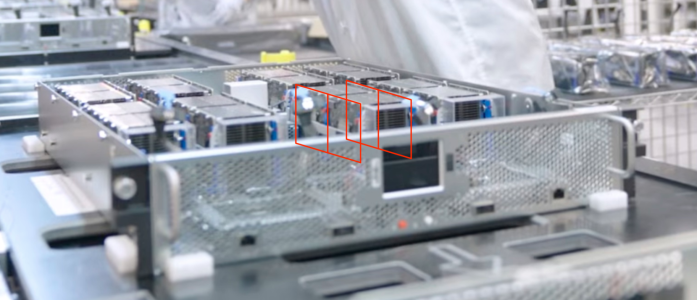
Looks like a 32 CPU setup. There are sets sandwiched end-to-end as pairs. But, it also looks like a CPU board on both sides of the heat sinks, sharing the heat sink. Rather dense for a bunch of Studio boards. Or, could they be Mac Mini boards?

1771965625855-1.png
 
Last edited:
Looks like a 32 CPU setup. There are sets sandwiched end-to-end as pairs. But, it also looks like a CPU board on both sides of the heat sinks, sharing the heat sink. Rather dense for a bunch of Studio boards. Or, could they be Mac Mini boards?
Probably modified Studio boards.
 
Apple does not use advanced nodes for Nx and Cx chips (at least not yet). The next-generation C2 modem is also planned to be manufactured on the TSMC N4 node.

Still a minority of wafers sourced in the US even assuming 100% of C/N chips are made by TSMC. There are other chips like CMOS image sensors that could be made in the US so I imagine they will exceed a 50% threshold if they push all that here.

I know people will bring up DRAM/NAND but Apple was already sourcing the majority of that in the US since Micron and Samsung have operated large memory fabs here for some time.

What really matters from their perspective though is the perception, not the reality. That's where the big xxx billion headline numbers are important. Trump tries to claim it as new investment and his followers believe him, even though it is nearly all ongoing investment. i.e. the $350 billion commitment Cook announced in 2017 and the $430 billion commitment he announced in 2021. Take that $430 billion, factor in wafer price increases as they move to N2, sales volume increases, and overall inflation into account and violà you're basically at 2025's $600 billion (upped from the original $500) without making much in the way of material changes. Heck if the DRAM/NAND prices get bad enough he might increase that commitment to $700 billion without changing anything lol
 
Apple does not use advanced nodes for Nx and Cx chips (at least not yet). The next-generation C2 modem is also planned to be manufactured on the TSMC N4 node.
Yep. I'm not even sure that by unit, A/M series are half of their chip demand given how much expansion of support silicon Apple has done. The bigger problem is that TSMCs AZ plants are tied up making China bound AI/GPU stuff, and Apple is going to have to elbow into that space. I think there's much more demand upside for US based plants than supply can meet, and I think that'll be true for a while. So Apple can be very aspirational about buying domestically when there is no capacity to satisfy that, and that's sort of a function of both US and Taiwanese law. Apple would buy 2nm in the US if Taiwan allowed it, and they'd buy 4nm in the US if China bound AI chips weren't required by the US govt to be made in the US, soaking up all capacity.
 
Still a minority of wafers sourced in the US even assuming 100% of C/N chips are made by TSMC. There are other chips like CMOS image sensors that could be made in the US so I imagine they will exceed a 50% threshold if they push all that here.
The video said 10000 wafers per month in the US, and >100000 wafers per month in Taiwan, so Taiwan has over 10X the volume of the US. Also, to ramp up to 100000 wafers per month in the US would take a decade a more.
 
The press keeps pushing the lie that Apple is going to be sourcing its chips from the US when those Arizona plants are ready. They will always be one generation behind Taiwan - there's even a LAW requiring this in Taiwan - so Apple will always be getting the bulk of their chips overseas.

The only way that changes is if Taiwan is invaded or Apple switches to Intel someday.
Two types of people:
Those who see the world as it is today and assume change is impossible.
And those who see possible differences.

If the US demands Taiwan change a law, that law will change! That is common sense!
There's no need to make an issue of it today, given the facts on the ground are not yet ready. When the facts on the ground are ready, then negotiations can begin...
 
Looks like a 32 CPU setup. There are sets sandwiched end-to-end as pairs. But, it also looks like a CPU board on both sides of the heat sinks, sharing the heat sink. Rather dense for a bunch of Studio boards. Or, could they be Mac Mini boards?

View attachment 138771
12+4 (assuming M4 style clusters, which is hardly a slam dunk. 12+6 is also a real possibility). Not 16 (or 18).
Let's not turn ourselves into idiots by adopting marketing rhetoric. It's 12 P-cores and that's the engine that matters; the E-cores are there so that the P-cores can run at 100% without wasting time on trivial matters.

When I say "mac studio board" I'm pointing at (my assumption) of the kinda performance level. I don't mean literally mac studio boards; boards are "cheap enough" to design that a bespoke board for this form factor makes sense. For example whatever the blower solution is for the entire board, presumably it's different from the fan used in a mac studio.
 
12+4 (assuming M4 style clusters, which is hardly a slam dunk. 12+6 is also a real possibility). Not 16 (or 18).
Let's not turn ourselves into idiots by adopting marketing rhetoric. It's 12 P-cores and that's the engine that matters; the E-cores are there so that the P-cores can run at 100% without wasting time on trivial matters.

When I say "mac studio board" I'm pointing at (my assumption) of the kinda performance level. I don't mean literally mac studio boards; boards are "cheap enough" to design that a bespoke board for this form factor makes sense. For example whatever the blower solution is for the entire board, presumably it's different from the fan used in a mac studio.
Why would they be M4? It’s M5 based most likely
 
Why would they be M4? It’s M5 based most likely

If it is M5 based they can mix n match however many CPU and GPU chips they want. That seems like a big win for their needs so it is hard to imagine those are M4 - especially since M4 Max doesn't support Ultra style linkage and I can't seem them going all the way back to M3 for something they are building in 2026.
 
Back
Top