Ohh finally someone leaked it 🤣🤣Copper Shark. I guess I am an insider now wohoo.

-
We’re currently investigating an issue related to the forum theme and styling that is impacting page layout and visual formatting. The problem has been identified, and we are actively working on a resolution. There is no impact to user data or functionality, this is strictly a front-end display issue. We’ll post an update once the fix has been deployed. Thanks for your patience while we get this sorted.
You are using an out of date browser. It may not display this or other websites correctly.
You should upgrade or use an alternative browser.
You should upgrade or use an alternative browser.
Discussion Intel’s Unified Core: Hammer Lake
Page 9 - Seeking answers? Join the AnandTech community: where nearly half-a-million members share solutions and discuss the latest tech.
Complete with a lack of bold claims regarding how great or terrible it is based on said inside information, hence all the more believable 😉Copper Shark. I guess I am an insider now wohoo.
So will Intel be 'jumping the shark' with CSK? Or is it an amusing name for a return to form? Will be fun to see which one as it plays out.

poke01
Diamond Member
Goes along well with Arctic Wolf and Golden EagleCopper Shark. I guess I am an insider now wohoo.
There can be different physical design to hit different power and perf targetsAgreed. No idea why you're bringing up 5W though as lower power, including what I was referencing, is less than 2W per core.
Too bad @Kepler_L2 didn't leak the codename so no one will believe it's true.
Just wait for the MLID "Exclusive" leak next weekToo bad @Kepler_L2 didn't leak the codename so no one will believe it's true.

Saylick
Diamond Member
I fully expect a wtftech rumor article anyyyy day now.Just wait for the MLID "Exclusive" leak next week
Given how CLF perf projections look, I have my doubts on the E-cores being competitive with AMD in perf/watt even vs Turin Dense.Agreed. No idea why you're bringing up 5W though as lower power, including what I was referencing, is less than 2W per core.
Though maybe the terrible L3 bandwidth in that product just fcks the e-cores over super hard. Idk.
Well you said it yourself Intel L3 keeps botching design you can look at E core in PTL it's at the level of ARL-S perf/clockGiven how CLF perf projections look, I have my doubts on the E-cores being competitive with AMD in perf/watt even vs Turin Dense.
Though maybe the terrible L3 bandwidth in that product just fcks the e-cores over super hard. Idk.
More importantly it's not based off on Cove LineageSo essentially with UC Intels creating a core that’s area efficient, low power when it needs to be, clocks high and has high 1T.
That looks to be an achievable goal
What perf at 2W though any ballpark or what are the targetsAgreed. No idea why you're bringing up 5W though as lower power, including what I was referencing, is less than 2W per core.
?
Higher than Zen8 😛 Sorry for the silly response, but those targets will likely bear little resemblance to actual performance when eventually released. It's the same with AMD and elsewhere - early architecture modeling rarely pans out to the promised extent. It's certainly amusing when competition forecasts end up being more accurate than internal projections.What perf at 2W though any ballpark or what are the targets
?
Another interesting historical+forecast comparison that came up during lunch today was perf/process-normalized core area trends. Will Intel continue improving performance with roughly flat gate counts while AMD shows similar performance gains with markedly increased area?
Well yeah but still would have nice to know what SIR2K17 are they targeting at 2W per core is it more than 9 or less 🤔Higher than Zen8 😛 Sorry for the silly response, but those targets will likely bear little resemblance to actual performance when eventually released. It's the same with AMD and elsewhere - early architecture modeling rarely pans out to the promised extent. It's certainly amusing when competition forecasts end up being more accurate than internal projections.
Well that's to be seen we don't even know the gate count for either SKT/LNC/GLC or any modern coreAnother interesting historical+forecast comparison that came up during lunch today was perf/process-normalized core area trends. Will Intel continue improving performance with roughly flat gate counts while AMD shows similar performance gains with markedly increased area?
This job listing "news" has led to so many misleading pieces and takes esp. around "Hybrid era" or how 'P' and 'E' combos are dead, and some even managed to put "Unified Core" as a Royal Core tech.

 www.notebookcheck.net


Jim Keller's Royal Core project: Intel is actively developing Unified Cores to ditch separate P and E-cores in future CPU architectures
Jim Keller's Royal Core project was reportedly dismantled by Intel into individual technologies that could be used in different CPU architectures. One of these technologies was a Unified Core design that would see Intel ditch separate P and E-cores. It has now come to light that Intel is indeed...
www.notebookcheck.net
Kind of expected most Modern Tech journalist don't know anything what they are talking aboutThis job listing "news" has led to so many misleading pieces and takes esp. around "Hybrid era" or how 'P' and 'E' combos are dead, and some even managed to put "Unified Core" as a Royal Core tech.
Jim Keller's Royal Core project: Intel is actively developing Unified Cores to ditch separate P and E-cores in future CPU architectures
Jim Keller's Royal Core project was reportedly dismantled by Intel into individual technologies that could be used in different CPU architectures. One of these technologies was a Unified Core design that would see Intel ditch separate P and E-cores. It has now come to light that Intel is indeed...
This job listing "news" has led to so many misleading pieces and takes esp. around "Hybrid era" or how 'P' and 'E' combos are dead, and some even managed to put "Unified Core" as a Royal Core tech.
Jim Keller's Royal Core project: Intel is actively developing Unified Cores to ditch separate P and E-cores in future CPU architectures
Jim Keller's Royal Core project was reportedly dismantled by Intel into individual technologies that could be used in different CPU architectures. One of these technologies was a Unified Core design that would see Intel ditch separate P and E-cores. It has now come to light that Intel is indeed...
Well, all of these Unified Core information are all rumors while Intel doesn't dare to say anything about future, calling them 'misleading' is still more or less unfair. But I agree 'Ditching hybrid core' might be incorrect and 'ditching hybrid architecture' is assured to be real though.
They are not ditching Hybrid Cores lmao HX 370 is a hybrid design with both the cores derived of the same uArchWell, all of these Unified Core information are all rumors while Intel doesn't dare to say anything about future, calling them 'misleading' is still more or less unfair. But I agree 'Ditching hybrid core' might be incorrect and 'ditching hybrid architecture' is assured to be real though.
Last edited:
I fully expect a wtftech rumor article anyyyy day now.
I definitely need a full, at least 5 paragraphs long article on this code name.
Saylick
Diamond Member
So since Unified Core will be a derivative of their E core, it makes me wonder how much bigger it would be if they were to modify it to be at feature parity with their P core lineup. For example, Skymont and Darkmont's FPUs are 4x128-bit. To reach parity with their P cores, they'll have to double the width of the FPUs and associated pathways.
For reference, for Zen 5 you can see how much area going from half-pumped to a true full 4x256-bit FPU required:
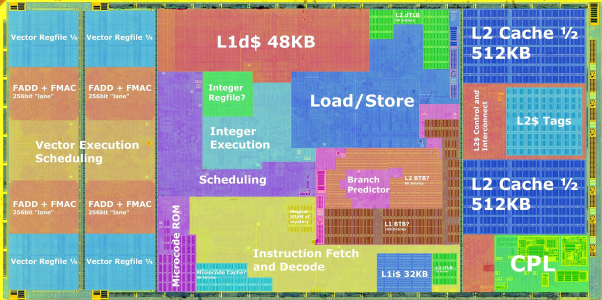
Currently, E cores are ~1/3 the area of their P cores. I wonder if Unified Core would be like 1/2 the area...
For reference, for Zen 5 you can see how much area going from half-pumped to a true full 4x256-bit FPU required:
Currently, E cores are ~1/3 the area of their P cores. I wonder if Unified Core would be like 1/2 the area...
LightningZ71
Platinum Member
Intel's E cores also lack the "slack" space and extra transistors that their P cores require to achieve their target Fmax. That has a marked effect on the area of the E cores.
The question is how hard the fabric screws the E-cores here.Well you said it yourself Intel L3 keeps botching design you can look at E core in PTL it's at the level of ARL-S perf/clock
The 17% IPC gain from Sierra Glenn to Darkmont is far behind the 34% IPC gain Huang saw in ARL-H E-cores vs MTL-H iso clock.
However, the perf/watt situation looks really bad here given what a 288 core Clearwater Forest matching as 192 core Turin Dense part ~iso power. Assuming a optimistic 1.3x SMT gain iso power (SMT gains iso power are pretty bad for AMD at low frequencies/power), you would get each AMD dense core being ~15% higher perf/watt than a darkmont core.
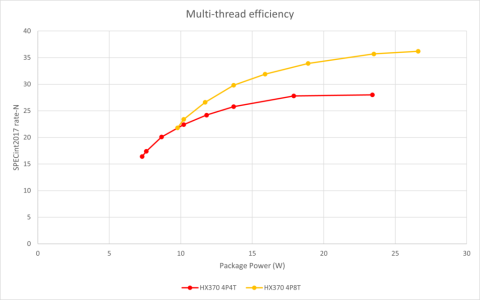
Maybe if we attribute all of the "missing" IPC gain Darkmont/Skymont sees in client but not in server, and pretend it costs no power what so ever, we would see a Darkmont core be ~ Zen 5 dense on N3E perf/watt, however that starts to look a lot less impressive again when we note that Turin Dense has less advanced packaging and also blows a bunch of area on full width avx-512.
Quite frankly, I don't think the E-cores are great in power as a whole. Even in Huang's data, where the shared L2 power is also being omitted from the power graphs, the E-cores don't seem amazing vs AMD's classic cores in power either.
Looks at SNC and GLCAnother interesting historical+forecast comparison that came up during lunch today was perf/process-normalized core area trends. Will Intel continue improving performance with roughly flat gate counts while AMD shows similar performance gains with markedly increased area?
Intel has had plenty of experience of improving performance while blowing up area. LNC doesn't look like it greatly increased core buffers/capacity dramatically vs SNC and GLC, but it also didn't see nearly as strong of an IPC uplift as those cores. And it blew up the core private caches instead.
Yup, and Zen 5 mobile, which still has AVX-512 mind you, has half the FPU area as desktop/server Zen 5.For reference, for Zen 5 you can see how much area going from half-pumped to a true full 4x256-bit FPU required:
I think you overestimate how small unified core will be. Current E-cores are already like ~40% the area of the P-cores once you take into account the fact that the P-cores spend a bunch of area on huge core private caches.Currently, E cores are ~1/3 the area of their P cores. I wonder if Unified Core would be like 1/2 the area...
And as ....
... states, you also save a bunch of area targeting lower Fmax. There are already tons of graphs showing how poorly area scales when you try to hit extremely high clocks.Intel's E cores also lack the "slack" space and extra transistors that their P cores require to achieve their target Fmax. That has a marked effect on the area of the E cores.
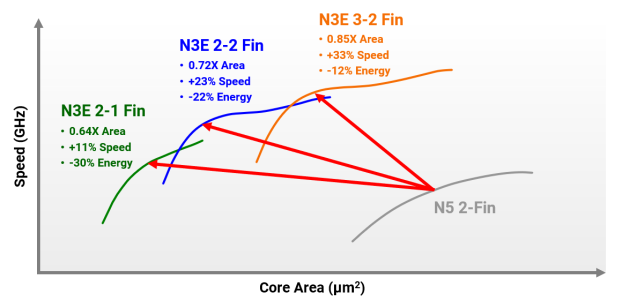
I think this is actually going to play a big part in either Arctic Wolf not improving IPC a bunch, or having to increase area (relative to the p cores) a good bit tbh. We will see how this ages in a couple of months ig lol.To reach parity with their P cores, they'll have to double the width of the FPUs and associated pathways.
There's also an interesting case study out there with the C1 ultra vs C1 premium. Both archs are very similar except for the FPU, where the C1 premium FPU is cut down significantly.
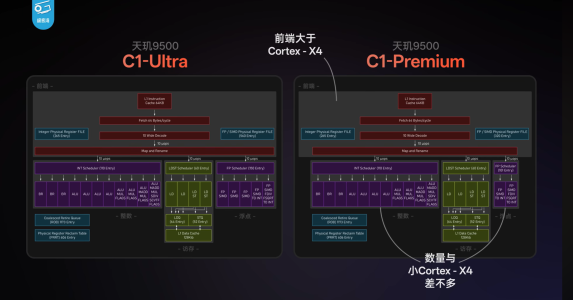
And the C1 ultra can also clock ~1.2x faster than the C1 premium as well. However, the C1 ultra is significantly larger than the C1 premium. One can prob look at the mediatek 9500 die shot and get an exact percentage, but it's large.
Just Spam the cores for MT that's what the area efficiency is for.The question is how hard the fabric screws the E-cores here.
The 17% IPC gain from Sierra Glenn to Darkmont is far behind the 34% IPC gain Huang saw in ARL-H E-cores vs MTL-H iso clock.
However, the perf/watt situation looks really bad here given what a 288 core Clearwater Forest matching as 192 core Turin Dense part ~iso power. Assuming a optimistic 1.3x SMT gain iso power (SMT gains iso power are pretty bad for AMD at low frequencies/power), you would get each AMD dense core being ~15% higher perf/watt than a darkmont core.
View attachment 138788
Advanced doesn't mean anything if you botch the design look at PVC it got the most advanced packing during it's time but fell flat core team relys on fabric team but they fall flat on the face each time in DC it's with PTL they didn't fall.Maybe if we attribute all of the "missing" IPC gain Darkmont/Skymont sees in client but not in server, and pretend it costs no power what so ever, we would see a Darkmont core be ~ Zen 5 dense on N3E perf/watt, however that starts to look a lot less impressive again when we note that Turin Dense has less advanced packaging and also blows a bunch of area on full width avx-512.
Their design target is perf/mm2 even than they are close to or better than their P core parts by a decent bit not that it is something to write home about.Quite frankly, I don't think the E-cores are great in power as a whole. Even in Huang's data, where the shared L2 power is also being omitted from the power graphs, the E-cores don't seem amazing vs AMD's classic cores in power either.
Don't remember SIR2K17 Relying so heavily on FPULooks at SNC and GLC
Intel has had plenty of experience of improving performance while blowing up area. LNC doesn't look like it greatly increased core buffers/capacity dramatically vs SNC and GLC, but it also didn't see nearly as strong of an IPC uplift as those cores. And it blew up the core private caches instead.
Yup, and Zen 5 mobile, which still has AVX-512 mind you, has half the FPU area as desktop/server Zen 5.
Well it's 1.12mm2 Core + L1 for SKT vs 2.51mm2 FOR Lion Cove Core+L0+L1 so yeah theI think you overestimate how small unified core will be. Current E-cores are already like ~40% the area of the P-cores once you take into account the fact that the P-cores spend a bunch of area on huge core private caches.
And as ....
Well have to see with Arctic wolf cause it's 256b pipes up from 128b... states, you also save a bunch of area targeting lower Fmax. There are already tons of graphs showing how poorly area scales when you try to hit extremely high clocks.
View attachment 138789
I think this is actually going to play a big part in either Arctic Wolf not improving IPC a bunch, or having to increase area (relative to the p cores) a good bit tbh. We will see how this ages in a couple of months ig lol.
Someone needs to measure it.There's also an interesting case study out there with the C1 ultra vs C1 premium. Both archs are very similar except for the FPU, where the C1 premium FPU is cut down significantly.
View attachment 138790
And the C1 ultra can also clock ~1.2x faster than the C1 premium as well. However, the C1 ultra is significantly larger than the C1 premium. One can prob look at the mediatek 9500 die shot and get an exact percentage, but it's large.
Yes, but it does mean esentially free power advantages compared to iFOP that AMD server currently uses.Advanced doesn't mean anything if you botch the design
Maybe, but given the E-cores currently aren't great at power, it's not a given that unified core would be either. In fact, power seems to be the biggest weakness of both the E and P-core team compared to the competition. The E-core teams are pretty good at area, and the P-core team is hanging on against the x86 competition in ST perf at least...Their design target is perf/mm2 even than they are close to or better than their P core parts by a decent bit not that it is something to write home about.
Not saying @adroc_thurston is right about unified core power, god knows how much he has gotten wrong before lol, but it's not hard to believe...
The last line you quoted was in response to how area increases when you have to widen the FPU (which unified core would have to do vs current E-cores), not specint2017 perf or anything.Don't remember SIR2K17 Relying so heavily on FPU
My point with that was if simply reducing how effective your avx-512 implementation is saves you half of your FPU area, how much area would the E-cores have to add in order to get a P-core class AVX-512 capable FPU for unified core?
Even with Arctic Wolf the E-core team can prob get away with "double pumped" AVX-512 like Zen 4, but with unified core I'm expecting that they have to go a full 512 bit data path with their FPU.
I would lol but I unfortunately don't have my mouse rn :/ Kurnal has the die shots on his twitter.Someone needs to measure it.
uh they are decent for power why do you think PTL or ARL gets a decent bit higher MT score without SMT mostly due to the E cores as for ST perf E core team didn't get the Area budgetMaybe, but given the E-cores currently aren't great at power, it's not a given that unified core would be either. In fact, power seems to be the biggest weakness of both the E and P-core team compared to the competition. The E-core teams are pretty good at area, and the P-core team is hanging on against the x86 competition in ST perf at least...
Full fat avx-512 is expensive yes but what if even after adding AVX-512 you get a core that is better in PPA vs the current P core implementationThe last line you quoted was in response to how area increases when you have to widen the FPU (which unified core would have to do vs current E-cores), not specint2017 perf or anything.
My point with that was if simply reducing how effective your avx-512 implementation is saves you half of your FPU area, how much area would the E-cores have to add in order to get a P-core class AVX-512 capable FPU for unified core?
Even with Arctic Wolf the E-core team can prob get away with "double pumped" AVX-512 like Zen 4, but with unified core I'm expecting that they have to go a full 512 bit data path with their FPU.
TRENDING THREADS
-
 Discussion Zen 5 Speculation (EPYC Turin and Strix Point/Granite Ridge - Ryzen 9000)
- Started by DisEnchantment
- Replies: 25K
-
Discussion Intel Meteor, Arrow, Lunar & Panther Lakes + WCL Discussion Threads
- Started by Tigerick
- Replies: 25K
-
 Discussion Intel current and future Lakes & Rapids thread
- Started by TheF34RChannel
- Replies: 24K
-

-
