• We’re currently investigating an issue related to the forum theme and styling that is impacting page layout and visual formatting. The problem has been identified, and we are actively working on a resolution. There is no impact to user data or functionality, this is strictly a front-end display issue. We’ll post an update once the fix has been deployed. Thanks for your patience while we get this sorted.

Discussion RDNA 5 / UDNA (CDNA Next) speculation

Page 31 - Seeking answers? Join the AnandTech community: where nearly half-a-million members share solutions and discuss the latest tech.
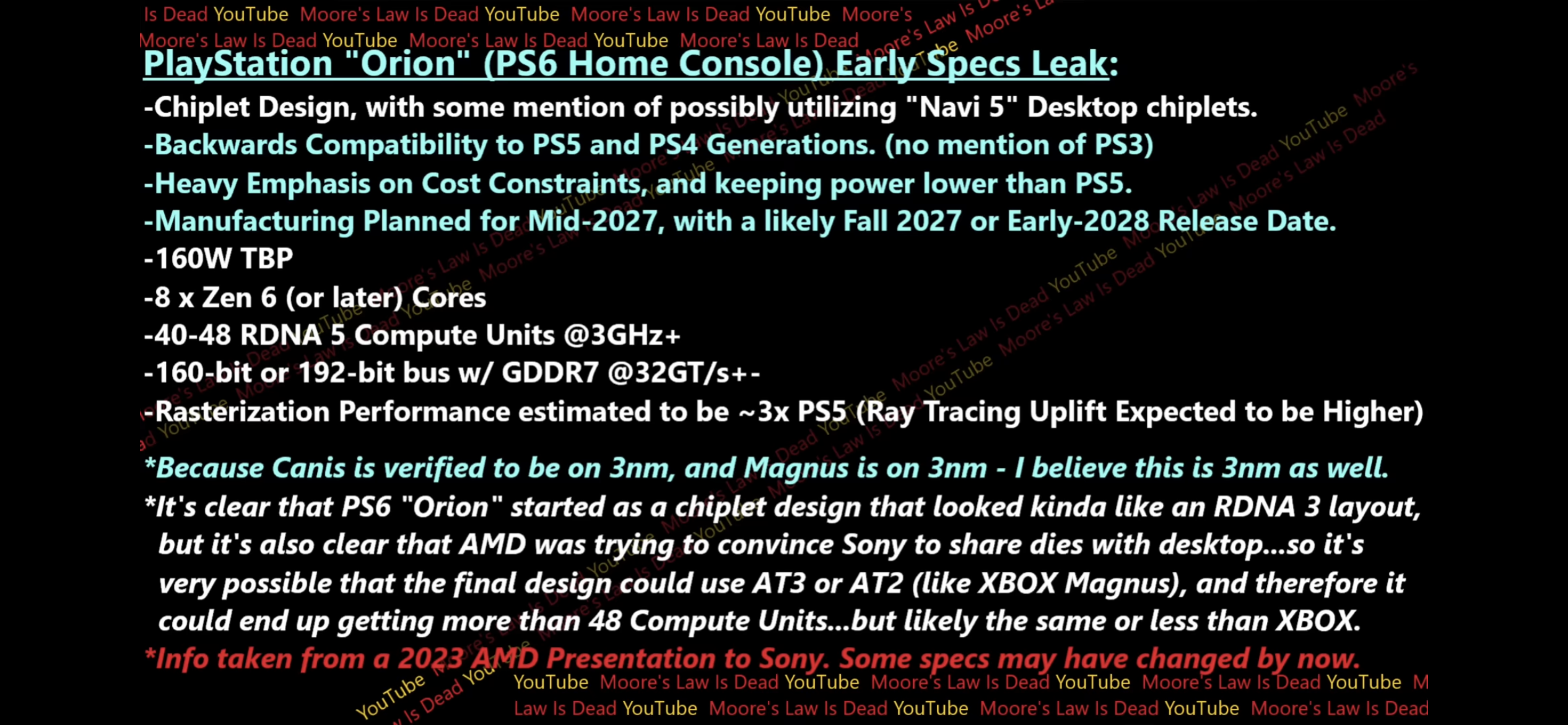
From AMD presentation 2023
ovJCj65Qu7V3BCmE.png
I mentioned this in the Zen 6 thread, but I seriously doubt AMD can get 3x the PS5 performance, which is comparable to a RTX 4080, in a 160W TBP with just one node advantage over the 4080.

That would imply that the PS6's GPU is twice the perf/W of the 4080, which itself was already a very efficient GPU of that generation. If AMD could have achieved 2x the perf/W of Ada using 3nm, it implies they could have gotten 1.5x the perf/W of Ada on N4, but we all know that didn't happen.
 
I mentioned this in the Zen 6 thread, but I seriously doubt AMD can get 3x the PS5 performance, which is comparable to a RTX 4080, in a 160W TBP with just one node advantage over the 4080.

That would imply that the PS6's GPU is twice the perf/W of the 4080, which itself was already a very efficient GPU of that generation. If AMD could have achieved 2x the perf/W of Ada using 3nm, it implies they could have gotten 1.5x the perf/W of Ada on N4, but we all know that didn't happen.
Should be possible with 2nm right ?
 
but I seriously doubt AMD can get 3x the PS5 performance, which is comparable to a RTX 4080, in a 160W TBP with just one node advantage over the 4080.
I bet its just counting tflops since base PS5 is just old RDNA2.

but outside of performance expectations, 48cu of a next gen GPU running at 160w isn't remotely that far fetched


I mean what is the relative performance of RDNA 2 to RDNA4? Its about 2x at iso clocks isn't it? should be pretty easy for AMD to squeeze out 3x with RDNA5. even without marking gimmicks/MLID larping
 
I bet its just counting tflops since base PS5 is just old RDNA2.

but outside of performance expectations, 48cu of a next gen GPU running at 160w isn't remotely that far fetched


I mean what is the relative performance of RDNA 2 to RDNA4? Its about 2x at iso clocks isn't it? should be pretty easy for AMD to squeeze out 3x with RDNA5. even without marking gimmicks/MLID larping
I'll believe it when I see it. I think the PS6 is another incremental step, not unlike how the PS5 Pro was an incremental step over the base PS5. My gut tells me it's closer to 2x the PS5 in raw raster, 3x in raw raytracing, and with some form of AI upscaling you get another 50% on top of those figures.
 
I'll believe it when I see it. I think the PS6 is another incremental step, not unlike how the PS5 Pro was an incremental step over the base PS5. My gut tells me it's closer to 2x the PS5 in raw raster, 3x in raw raytracing, and with some form of AI upscaling you get another 50% on top of those figures.
Honestly, I think those would be great targets to hit even. I think the bigger uplift is going to come on the CPU side and total system memory bandwidth. Bigger might not be the best word for it - but if we get Zen 5C/Zen 6C with some Sony specific optimizations for die size that's going to be a lot of CPU efficiency uplift that could potentially bring some watts back to the GPU.

Anyway, its the next step I'll take since I decided to skip the Pro and haven't found any reason to regret it yet.
 
given that release is planned for 2027 or later then it could easily be RDNA 6
No
It is more like a PS5 handheld

Could even release before the PS6, I reckon
No
My gut tells me it's closer to 2x the PS5 in raw raster, 3x in raw raytracing, and with some form of AI upscaling you get another 50% on top of those figures.
A 48 CU RDNA4 GPU would already go beyond that
 
They should be able to match rtx 50xx series

What happens with 60xx series is another matter
Well RTX 60 is very likely to be a Blackwell+ on a shruken node. AMD (and Intel as well) just got to have a very good guess where that'll be.
I have doubts on the chiplet stuff. But if it is really a chiplet & given that release is planned for 2027 or later then it could easily be RDNA 6
Maybe some RDNA 6 stuff if this is a fully custom and not "throw in a ATx chiplet with the custom CPU & IOD Chiplet" SoC.
 
It just wouldn't be cheap.
Let's say 20x20mm chip = 400 sq mm, just over 9070XT with new arch, higher freq, faster VRAM.

Dies per wafer: 140 (minus yield of course).

Wafer cost: say $20k for N3

Cost: $142 (with perfect yield of course), sell price to Sony: say $300 to keep fat gross margins.

Or maybe Sony just buys its own wafers and getting manufacturing at cost, which I think is current arrangement, they only pay AMD for semi work, license etc.

So it follows maybe one chip can be had for $200, leaving $300 for other stuff like VRAM, NVME, which seems plenty. AMD already got partnership with Sony, they'll benefit for their next GPU being nicely aligned with Sony's stuff because their console is here to stay for a very very long time.
 
STX Halo reaches like 95% of its gaming performance at 55W, matching a PS5 a Series X. And that's with an extra CCD die that won't be of any use for games.

AMD could make a 3nm chip that has 3x PS5 raster performance at 160W today. It just wouldn't be cheap.
True but Strix Halo is arguably power constrained because despite having equal amount of CUs to the 6070 XT and 6800M, it doesn't perform close to neither AFAIK.
 
True but Strix Halo is arguably power constrained because despite having equal amount of CUs to the 6070 XT and 6800M, it doesn't perform close to neither AFAIK.
Due to Infinity Cache and higher clocks on the desktop RDNA2 cards, the PS5 and Series X perform close to the 6700 non-XT.

The Radeon 8060 at 50-60W does perform close to a Radeon 6700 10GB. They're both comparable to a laptop 4070 or 4060 ti desktop.
 
Back
Top