Since this small core needs to be a more power saving core than the big core sibling, A75. I would imagine they retain the in-order execution for the upcoming A55.Wondering if A55 is out of order like A57 and A72 or in order like A35 or A53...

-
We’re currently investigating an issue related to the forum theme and styling that is impacting page layout and visual formatting. The problem has been identified, and we are actively working on a resolution. There is no impact to user data or functionality, this is strictly a front-end display issue. We’ll post an update once the fix has been deployed. Thanks for your patience while we get this sorted.
You are using an out of date browser. It may not display this or other websites correctly.
You should upgrade or use an alternative browser.
You should upgrade or use an alternative browser.
Mobile chips 2017: Qualcomm, Mediatek, Exynos and More
Page 5 - Seeking answers? Join the AnandTech community: where nearly half-a-million members share solutions and discuss the latest tech.
I say that because there is the ARM A35 as the in order core... and A55 seems more like a more power efficient A57...Since this small core needs to be a more power saving core than the big core sibling, A75. I would imagine they retain the in-order execution for the upcoming A55.
Only architectures released from now are compatible with the new DynamIQ, so you can't mix A75+A35 ( i read that in ARM web ). And there is a big gap in performance between A55 and A57 they have nothing in common, it is designed for effiency at low tasks.I say that because there is the ARM A35 as the in order core... and A55 seems more like a more power efficient A57...
Ok.. so A35 ended to be a failed core? Time for a rework for them?Only architectures released from now are compatible with the new DynamIQ, so you can't mix A75+A35 ( i read that in ARM web ). And there is a big gap in performance between A55 and A57 they have nothing in common, it is designed for effiency at low tasks.
No, it was a improved version of Cortex A7 with 64bit support. Actually it is supposed to be a bit more efficient compared to A53 at the cost of some perfomance lost.Ok.. so A35 ended to be a failed core? Time for a rework for them?
From what i know, ARM decided to have three different envelopes for their cortex core: Ultra high efficiency, high efficiency and high performance.I say that because there is the ARM A35 as the in order core... and A55 seems more like a more power efficient A57...
A35 is in the ultra high efficiency i.e low performance envelope, lower than even A53. Not even fit for normal smartphone use case on its own. Unlike current A53 and it's successor, A55.
As for A55, based on the leaked info, the performance of A55 is in general around 20% better than A53. Which is consistent with its performance envelope.
From the business point of view, they (ARM) simply cannot boost the performance of their mid-range core too much as they need to keep a reasonable gap between A55 and A75 as they did with A53 and A73.
Otherwise their licensee would simply go for A55 as the "performance core" in their SoC instead of A75 for most of their high mid-range and low high-end while only reserve A75 for a very high-end model. This in my view would limit ARM's potential income from A75 fee.
Anyway, this is just my thinking. Feel free to correct me wherever possible. As we learn and exchange information and opinion with each other.
Last edited:
But... Was is supposed to be compatible with the higher tier cores like the A7?No, it was a improved version of Cortex A7 with 64bit support. Actually it is supposed to be a bit more efficient compared to A53 at the cost of some perfomance lost.
I guess that someone must ask for them on the official presentation.
If is compatible it would mark the end of big.LITTLE and mark the beginning of the Cluster designs.
That's because it would be a big incoherency from ARM to leave the low power core outside this array and it would not improve more than expecting.
Actually the A32 is there for you said. It even doesn't need to be at 64 bit.The A35 target usage is as a ultra low cost and power core in embedded, IoT and ultra low cost. It doesn't need to be in a BL design.
Disregarding DynamiQ interoperability, the new cores are simply incompatible with the old ones since they're ARMv8.2.
And it could confirm that A35 replacement should come soon.
imported_jjj
Senior member
imported_jjj
Senior member
Found a live feed for ARM's Computex event (already started) https://www.youtube.com/watch?v=ClCVaBkIgPk
Thanks for the link.Found a live feed for ARM's Computex event (already started) https://www.youtube.com/watch?v=ClCVaBkIgPk
As expected: A55 is still an in-order, dual-issue CPU with an 8-stage pipeline.
The new cores (A75 and A55) will not work with the older cores in a big.LITTLE configuration. It will only works between them (A75 + A55).But... Was is supposed to be compatible with the higher tier cores like the A7?
I guess that someone must ask for them on the official presentation.
If is compatible it would mark the end of big.LITTLE and mark the beginning of the Cluster designs.
That's because it would be a big incoherency from ARM to leave the low power core outside this array and it would not improve more than expecting.
Ok, it is confirmed by today... So A35 can be easily done now since A55 can be downscale as well.The new cores (A75 and A55) will not work with the older cores in a big.LITTLE configuration. It will only works between them (A75 + A55).
Since it can't be part of the Dynamic IQ and A32 is for IOT, A35 has no longer sense to exist and it will be in just one design win: the Mediatek Helio X30... A big dissapointment for that core. And a very short lived one.
What?Apple's WWDC conference keynote is on Monday; and they are expected to announce the A10X (?) iPad Pro. Unsure if it will be TSMC 10 nm or not.
Don't know if it will really hit the ~4200 ST GB4 score rumored a couple months ago, but that would be nice.
This one?

What?
This one?
That's the A11 though... not the A10X.
Would there any news from Intel or x86? Any hope to see new x86 mobile chips?
Intel has pretty much given up. Can't get Core down to the power levels and cost needed to be competitive. They are pretty much sticking with industrial uses.
If what you really want is W10, then you'll have to see how the W10 on ARM does.
Ive see the Win10 thing on SD835, but im just not sure, they avoided any kind of perf show, not sure about how good the part of x86 bin to ARM will work(and with what instruction support), in teory is the same system used to run x86 on Itanium, and the no x64 bin support is a big letdown.
Also the SD835 supports DX9/11??? it says DX12/Vulkan/ES 3.0.
Also the SD835 supports DX9/11??? it says DX12/Vulkan/ES 3.0.
New news from the web...
https://www.gizmochina.com/2017/06/03/snapdragon-660-powered-oppo-r11
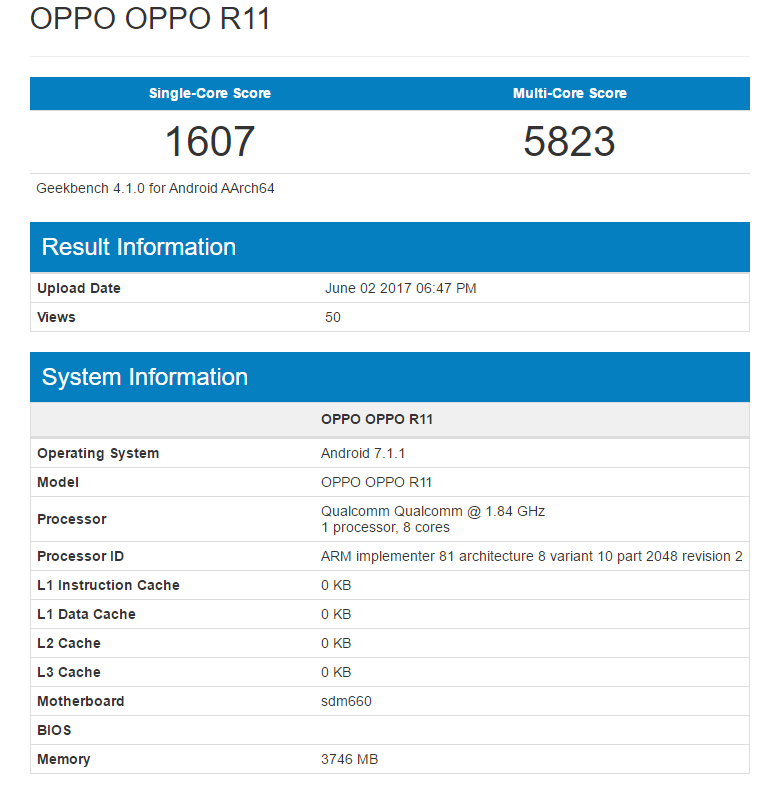
CPU wise it happened again... The new generation is defeating the old one... Kryo barely wins in Single Thread here due their FP performance. However on Multi Thread the massacre is done.
Meanwhile, is pending to see how the GPU was improved and how near they are from Adreno 530 or even if they defeated the Adreno 430.
https://www.gizmochina.com/2017/06/03/snapdragon-660-powered-oppo-r11
CPU wise it happened again... The new generation is defeating the old one... Kryo barely wins in Single Thread here due their FP performance. However on Multi Thread the massacre is done.
Meanwhile, is pending to see how the GPU was improved and how near they are from Adreno 530 or even if they defeated the Adreno 430.
Ive see the Win10 thing on SD835, but im just not sure, they avoided any kind of perf show, not sure about how good the part of x86 bin to ARM will work(and with what instruction support), in teory is the same system used to run x86 on Itanium, and the no x64 bin support is a big letdown.
I would not expect x86 games to work at all if that is what you are asking. Probably more like Office and other light productivity apps (although I would have to think MS would recompile Office to ARM)
Currently even some SW doesn't work on x86 at all due Idiot Programming on their finnest... Specially some games like MapleStory since even on a Haswell chip it crashes like nothing....I would not expect x86 games to work at all if that is what you are asking. Probably more like Office and other light productivity apps (although I would have to think MS would recompile Office to ARM)
I bet Xiaomi would love to have this chip in some their other phones (other than their Mi 6C). Perhaps it would end up in Redmi Note 5?New news from the web...
https://www.gizmochina.com/2017/06/03/snapdragon-660-powered-oppo-r11
CPU wise it happened again... The new generation is defeating the old one... Kryo barely wins in Single Thread here due their FP performance. However on Multi Thread the massacre is done.
Meanwhile, is pending to see how the GPU was improved and how near they are from Adreno 530 or even if they defeated the Adreno 430.
Indeed. It will end on the Global Version of the Redmi Note 5I bet Xiaomi would love to have this chip in some their other phones (other than their Mi 6C). Perhaps it would end up in Redmi Note 5?
And no... The Mi6C will have the in house core they are preparing.
I'm looking forward to seeing more of ARM new form of netbook. I might actually buy one after a few generations down the line.Ive see the Win10 thing on SD835, but im just not sure, they avoided any kind of perf show, not sure about how good the part of x86 bin to ARM will work(and with what instruction support), in teory is the same system used to run x86 on Itanium, and the no x64 bin support is a big letdown.
Also the SD835 supports DX9/11??? it says DX12/Vulkan/ES 3.0.
Perhaps the SoC (and Windows optimization for ARM) would be better by the time they go down to 7nm.
TRENDING THREADS
-
 Discussion Zen 5 Speculation (EPYC Turin and Strix Point/Granite Ridge - Ryzen 9000)
- Started by DisEnchantment
- Replies: 25K
-
Discussion Intel Meteor, Arrow, Lunar & Panther Lakes + WCL Discussion Threads
- Started by Tigerick
- Replies: 25K
-
 Discussion Intel current and future Lakes & Rapids thread
- Started by TheF34RChannel
- Replies: 24K
-

-
