• We’re currently investigating an issue related to the forum theme and styling that is impacting page layout and visual formatting. The problem has been identified, and we are actively working on a resolution. There is no impact to user data or functionality, this is strictly a front-end display issue. We’ll post an update once the fix has been deployed. Thanks for your patience while we get this sorted.

Question x86 and ARM architectures comparison thread.

Page 32 - Seeking answers? Join the AnandTech community: where nearly half-a-million members share solutions and discuss the latest tech.

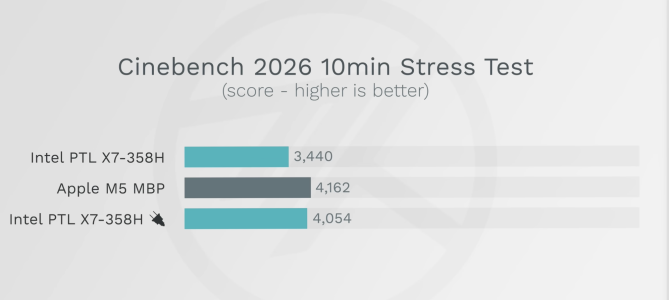
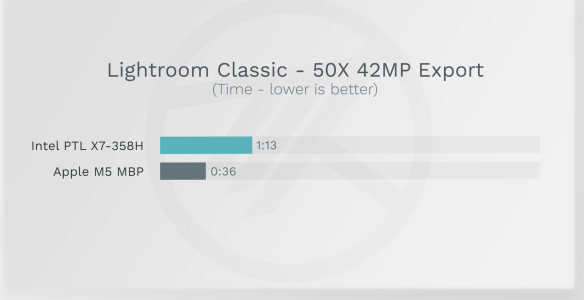
MaxTech did some benchmarks with Panther Lake. I will post the relevant screenshots here, so you all don't need listen to the hyper voice every 2 seconds.


Lightroom:
1771130597379.png


Cinebench 2026:
1771130650598.png

Gotta say Intel/AUUS still drops performance on battery by default, probably why it lost in the lightroom test.
 

MaxTech did some benchmarks with Panther Lake. I will post the relevant screenshots here, so you all don't need listen to the hyper voice every 2 seconds.


Lightroom:
View attachment 138344


Cinebench 2026:
View attachment 138345

Gotta say Intel/AUUS still drops performance on battery by default, probably why it lost in the lightroom test.
People benching nT perf on battery aren't serious and should consider different life decisions.
 
I'll bite. Why?
Two reasons:
  • Most people don't run nT-heavy workloads such as rendering on battery, mostly because the battery isn't going to last very long;
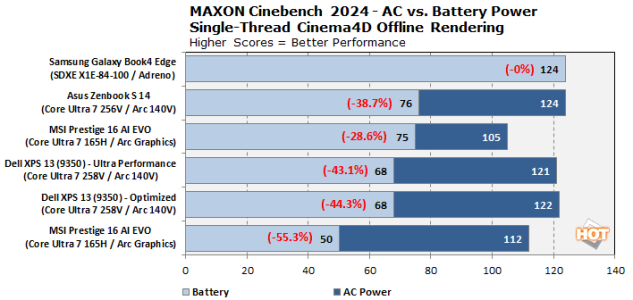
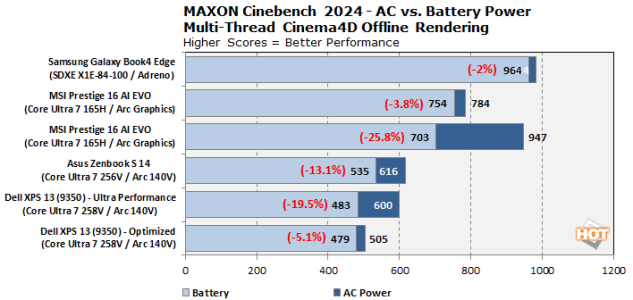
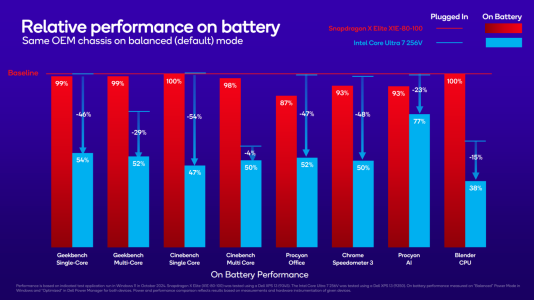
  • The lightly threaded workloads actually drop much more perf on battery compared to heavy threaded.
Notice how Cinebench nT score drops much less on LNL compared to Cinebench 1t, or Blender compared to Speedometer. So it's not really representative to test nT workloads on battery to draw meaningful conclusions about plugged/on battery perf delta.
1771154252441.png
1771154750625.png
1771154763933.png
 
Last edited:
Most people don't run nT-heavy workloads such as rendering on battery, mostly because the battery isn't going to last very long
It’s not even rendering. Even basic stuff like Lightroom export is slower on battery and that also means video exports will be slower than when plugged in. Most people that buy these laptops will never change the power profiles and but they did pay for performance that they will never get on battery.

It’s why I highlighted it. No one sane is going to be doing rendering on a tiny iGPU in a professional capacity but the Cinebench test highlights how even simple stuff is throttled when it doesn’t need to be.
 
Last edited:
Two reasons:
  • Most people don't run nT-heavy workloads such as rendering on battery, mostly because the battery isn't going to last very long;
  • The lightly threaded workloads actually drop much more perf on battery compared to heavy threaded.
Speak for yourself. Pretty nice gaming on my patio on my MBP, feet up. Battery lasts nearly all day, even under gaming load.

I've mentioned before that I did a lot of data science in my career. You would be surprised how much of my work was done in conference rooms, on my patio, on airplanes, at conferences, etc. A lot of the reason why people don't run heavy workloads is because Windows laptops suck, not because they don't have a need to run heavy workloads.
 
Two reasons:
  • Most people don't run nT-heavy workloads such as rendering on battery, mostly because the battery isn't going to last very long;
  • The lightly threaded workloads actually drop much more perf on battery compared to heavy threaded.
Second point is valid. 1T should drop even less compared to nT IMO, not the other way around.

Speak for yourself. Pretty nice gaming on my patio on my MBP, feet up. Battery lasts nearly all day, even under gaming load.

I've mentioned before that I did a lot of data science in my career. You would be surprised how much of my work was done in conference rooms, on my patio, on airplanes, at conferences, etc. A lot of the reason why people don't run heavy workloads is because Windows laptops suck, not because they don't have a need to run heavy workloads.
I'm with this comment regarding the use of nT. I agree that no one is running cinememe on the go, but the reason why people don't run stuff (data science etc) on windows laptops is because they can't do it well unplugged. I personally do run heavy stuff on my Windows laptop unplugged, and it frustrates me that I have to plug it in to get the max performance.
 
An interesting review of Cortex-X925 by Cheeps and Cheese:

Very strong integer performance and performance per clock. FP is just good (I guess 128-bit wide registers are the reason).
The heavy downgrade of 9800x3d spec scores between this comparison and original 9800x3d piece suggest they have changed something in the setup. [9900x also seems to score too high in fp part]


Maybe different reviewer.

Other than that, nice write up.
 
The heavy downgrade of 9800x3d spec scores between this comparison and original 9800x3d piece suggest they have changed something in the setup. [9900x also seems to score too high in fp part]


Maybe different reviewer.
In the older article the reviewer ran DDR5 6000. Here the reviewer runs DDR5 5600:
Running Zen 5 with faster DDR5-6000 instead of DDR5-5600 memory can slightly increase its integer score, but only to 11.9

It's also possible both reviewers used different compiler and/or flags. Too bad neither of them provided that information.
 
An interesting review of Cortex-X925 by Cheeps and Cheese:

Very strong integer performance and performance per clock. FP is just good (I guess 128-bit wide registers are the reason).

I must have been living in a hole but X925 seems rather amazing to be able to basically match AMD and Intel's best desktop chips (at least in SPEC) and at a much lower clock speed. It's crazy how much better it is than even Darkmont.

Am I misreading C&C's article? Is anyone else surprised at how performant X925 is?
 
I must have been living in a hole but X925 seems rather amazing to be able to basically match AMD and Intel's best desktop chips (at least in SPEC) and at a much lower clock speed. It's crazy how much better it is than even Darkmont.

Am I misreading C&C's article? Is anyone else surprised at how performant X925 is?
X925 is absolutely hueg of a core, so I'm not surprised to see it perform well, but I am surprised that it's this close in memory-latency sensitive benchmarks such as 520.omnetpp.
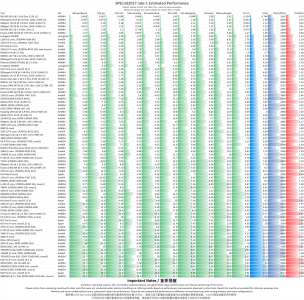
Huang's SPEC data seems to more or less align with CnC.

And that BPU is genuinely world-class, this level of perf in 541.leela is very impressive.
1772578727931.png
 
X925 is absolutely hueg of a core, so I'm not surprised to see it perform well, but I am surprised that it's this close in memory-latency sensitive benchmarks such as 520.omnetpp.
Huang's SPEC data seems to more or less align with CnC.

And that BPU is genuinely world-class, this level of perf in 541.leela is very impressive.
View attachment 139198
Dang, seeing X925 go toe-to-toe on IPC with Apple's latest P core is very impressive. I believe they're on the same node, too (N3P) so now I'm curious as to how they compare in power and area.
 
I must have been living in a hole but X925 seems rather amazing to be able to basically match AMD and Intel's best desktop chips (at least in SPEC) and at a much lower clock speed. It's crazy how much better it is than even Darkmont.

Am I misreading C&C's article? Is anyone else surprised at how performant X925 is?

Cortex-X gen-to-gen improvements have been pretty crazy for a while now.
 
I think it's neat and telling they went large private L2 with a small way to size ratio. 1:4 way:MB. In addition where apple has a 4-6 core to shared 12MB and size to way ratio is 1:1.

They are really stepping into and in some ways (pun) past x86 cache provisioning.

Though apple still has some advantages with their low latency L3 like L2.
 
Judging by the D9500, the C1U is a bit of an incremental update over X925 (understandable really, can't keep making double digit-increases every year), but other than that yea, the Cortex X has been very impressive.
they have made quite some changes for an incremental upgrade
 
Photonic chips like Q.ANT are interesting, but they’re not directly comparable to x86, ARM, or GPUs like NVIDIA Blackwell.

They’re usually highly specialized accelerators — potentially much faster for specific AI/math workloads — but far less flexible than general-purpose CPUs/GPUs. The real question is software ecosystem and real-world usability.

Would be interesting to see real benchmarks once silicon is widely tested.
 
Odd considering it was the 1st consumer ARM chip with 6x 128 bit NEON/SVE ALUs.
There might several explanations to that:

- the Ryzen still has wider total FP datapaths
- better vectorization (compiler and/or flags); instructions retired for cactubssn, roms (this one likely uses AVX-512 given the difference between Ryzen and Lion Cove), fotonik3d and wrf seem to show that
- few or none of the workloads can fully exploit 6 data paths, or the X925 dispatch engine is not up to the task for feeding 6 units.

Just guessing, I'm not familiar with SPEC FP.
 
I must have been living in a hole but X925 seems rather amazing to be able to basically match AMD and Intel's best desktop chips (at least in SPEC) and at a much lower clock speed. It's crazy how much better it is than even Darkmont.
While both x86 vendors keep spending transistors on adding throughput - fully 512b FP infrastructure, single-purpose ISA extensions, and advances in SMT. ARM still goes for the general performance. Is this take correct?

Is there a die size comparison between X925 (or newer) and Zen 5/AVX 512 Intel?
 
There might several explanations to that:

- the Ryzen still has wider total FP datapaths
- better vectorization (compiler and/or flags); instructions retired for cactubssn, roms (this one likely uses AVX-512 given the difference between Ryzen and Lion Cove), fotonik3d and wrf seem to show that
- few or none of the workloads can fully exploit 6 data paths, or the X925 dispatch engine is not up to the task for feeding 6 units.

Just guessing, I'm not familiar with SPEC FP.
Zen5 is just a chonkier core FP-wise, with 384entry FP PRF and stuff.
While both x86 vendors keep spending transistors on adding throughput - fully 512b FP infrastructure, single-purpose ISA extensions, and advances in SMT
No.
ARM still goes for the general performance. Is this take correct?
No.
AMD goes for server workload performance.
 
Back
Top