• We’re currently investigating an issue related to the forum theme and styling that is impacting page layout and visual formatting. The problem has been identified, and we are actively working on a resolution. There is no impact to user data or functionality, this is strictly a front-end display issue. We’ll post an update once the fix has been deployed. Thanks for your patience while we get this sorted.

fresh home build coming soon

Page 27 - Seeking answers? Join the AnandTech community: where nearly half-a-million members share solutions and discuss the latest tech.
Yes I am aware of the battery issues. I rolled the dice at that price point. Please note that it is not in my basement or against the outside wall. 🙂
I had leftover ICF blocks and built a battery vault into the retaining wall. There it is out the kitchen window. It gets a 4" foam core fiberglass epoxy lid on it that will be 4" above the pavers out there.
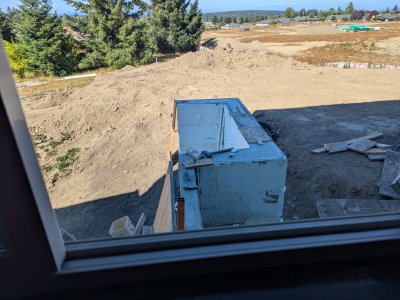
PXL_20250724_232331520-1.jpg
If it does not work out, I will replace it but the batteries will not go inside the house in any case.
That vault has it's own power outlet and will get a pair of doors and be conditioned as needed.
No we don't burn wood nor have propane or natural gas. All electric.

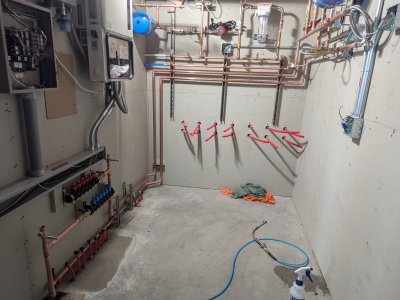
The equipment room is too small for the HPWH so it gets a louvered door to the rest of the basement shop area. It is conditioned and I will welcome the dehumidifier action of the water heater.

I worked in commercial plumbing and opted for a floor sink next to the water heater location. These are very handy for the leak pan, blow off valve, and the condensate drain.
The floor is slightly beveled into it so I can sweep a spill in there too.
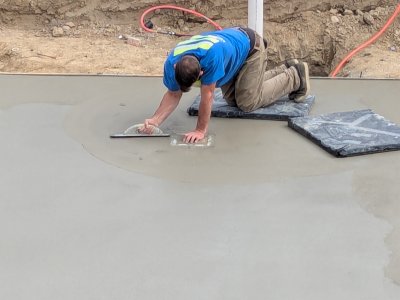
I had cut down all plumbing and conduit below grade so I could get a great finish. Here is the guy hand troweling around that floor sink, his hand is on it and it has 1/4" plywood on it still.
The water heater sits about where he is.
PXL_20240919_174213412.jpg

It is a zurn cast iron like this. I can get a split grate or just cut a full grate as needed.
2927293.jpg


I also put in a condensate drain across the room near the air handler. The room is otherwise finished flat, I don't care for sloped floors to drains and pipes running across or stains, and also trying to install stuff on a sloped floor. It just has that little bevel there.
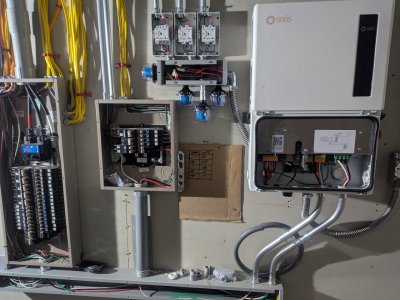
 
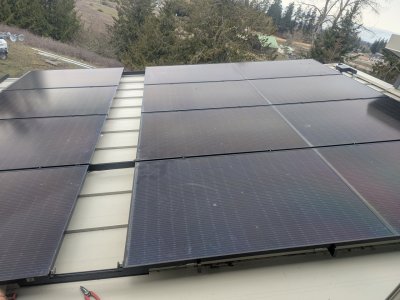
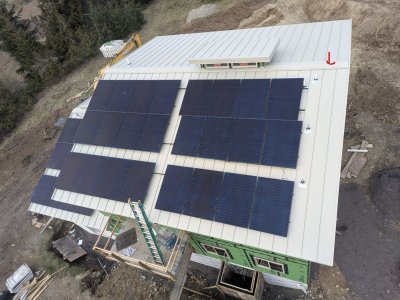
The PV wiring is complete to the inverter, and the battery conduit is complete to the vault. Tomorrow we will assemble the battery and pull in the wire.

PXL_20260130_011509098.jpg
My string layout had some exposed wires across this access. I used scraps of rail and spare clamps to guard them at the 3 places here on the West Wing.
PXL_20260129_210228149.jpg
 
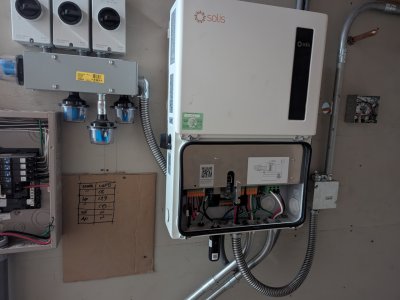
After we got the battery connected to both the feed and the RS485 BMS communications, I gave the inverter a sniff of the grid juice and connected with it via the app and Bluetooth. I had to quit that before updating firmware but I got as far as the battery and inverter talking, and I connected the solar panels and the integrated APS brand RSD control module sent the GO GO GO signal to the Panel Level RSD units and I saw some of that high voltage goodness.
With the panels damped by RSD, they put out ~0.8V per panel.
When the blue lights came on in the Surge Protection Devices (SPD), I was reading 442VDC on the big strings 😎
I can't get carried away with this testing until I get the grid agreement done with the utility.
Waiting is the hardest part.
 
After we got the battery connected to both the feed and the RS485 BMS communications, I gave the inverter a sniff of the grid juice and connected with it via the app and Bluetooth. I had to quit that before updating firmware but I got as far as the battery and inverter talking, and I connected the solar panels and the integrated APS brand RSD control module sent the GO GO GO signal to the Panel Level RSD units and I saw some of that high voltage goodness.
With the panels damped by RSD, they put out ~0.8V per panel.
When the blue lights came on in the Surge Protection Devices (SPD), I was reading 442VDC on the big strings 😎
I can't get carried away with this testing until I get the grid agreement done with the utility.
Waiting is the hardest part.

Nice setup on the bunker for the batteries. Your wiring looks really neat and clean.

You cannot configure your inverter to do zero grid export? When my system was installed I just configured my Sol-Ark inverters to do zero-grid export before I got PTO.
 
Nice setup on the bunker for the batteries. Your wiring looks really neat and clean.

You cannot configure your inverter to do zero grid export? When my system was installed I just configured my Sol-Ark inverters to do zero-grid export before I got PTO.
I can, but that is not how it will get employed. The only thing that would do is charge and then start cycling the battery. The house is not wired at the far end LOL!
That is more than a month away at least. So the only logical operation is to turn off all the load breakers as I have done, and start exporting.

Picture of what I mean:
PXL_20260124_013400268.jpg
Those would be great for backing into and getting shocked right now LOL.
 
Last edited:
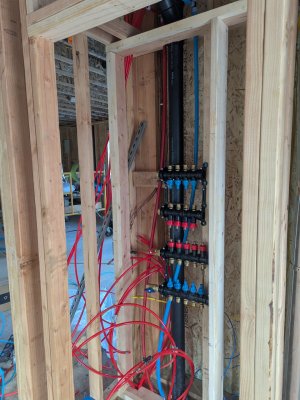
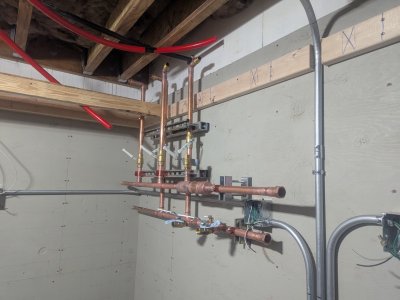
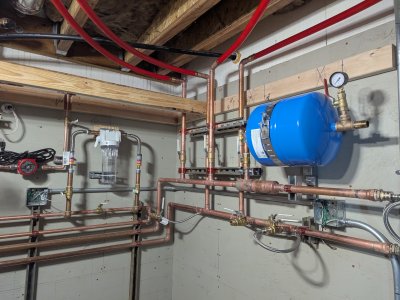
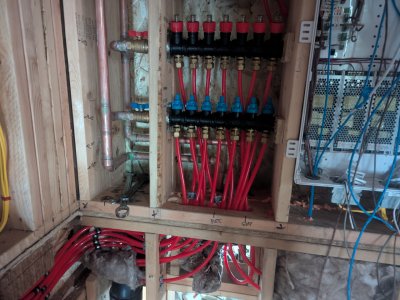
I daisychained that bunch of 3/8 pex spaghetti into one continuous 4000' loop for a 100 PSI pressure test. The inspector warned me that hooking it to the manifolds can cause problems at 100 PSI. Now I can locate and bolt down the manifolds, plumb it all up, run the 1" trunk lines to the equipment room and get my <master plumber of devices> up to build out the equipment room in sweat copper.
I could do propress, but the cost is high and no advantage when you have a pro doing the sweat work.
I am very fortunate to have a real graybeard of a guy who does all the complicated plant work for the company. I can do this stuff slowly and get by, but he has a vision in his head and it becomes a thing of beauty.
 
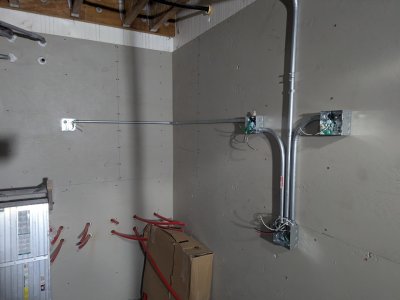
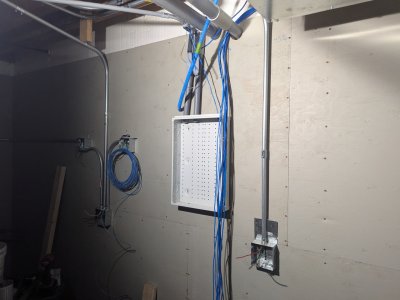
I put LB's on the 1" comm conduits coming in from outside, and a type T on the 1/2" from the inverter to the RSD switch location, which will also serve for the power meter.
Then I hung that little leviton cab that the lighting guys sold me.
PXL_20260208_001238289.jpg
The dropped ceiling is just below the bottom of the LB's.
I will frame in a hatch there. The baby Smurf goes up about 8' to midwall behind the future TV spot with a Cat6E along with it. I will leave a pull string in the smurf for future tech.
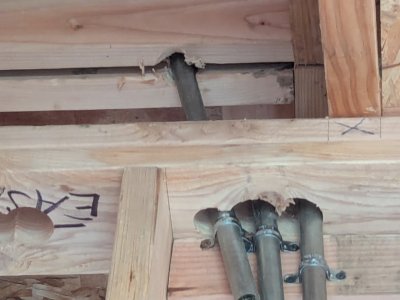
Up in that same hatch I ended a spare 3/4" EMT to the roof peak.
I burned up my Cat5E doing a few runs that may never get dug out of the wall. I'll drag a Cat6E
over to the low voltage box as well as a pair of 5E.
I had 7 boxes of rems left over from when I wired the office and church. That was back when Essex was pushing their "enhanced" 6, which is not an official spec. I like it for the 23Ga wire that might do a bit more with POE.
I hate all 6 for the PITA it is to terminate properly.
I took that EMT through the house for the price of the conduit and a half day of dinking around. It beats the heck out of cutting big holes in the sheetrock if I want to expand the PV installation some day. It ends 2" below the ridge vent screen under the roof cap.
PXL_20260207_233129305.jpg

It is as indicated in red here.
PXL_20250302_011146383.jpg
take a few screws out pull the ridge metal, cut and couple and a little hole in the ridge metal.
If my production falls short, I can add off-side panels for less than a buck a watt.
Production is good during the crucial summer months, even on the north side. The summer is when you make hay with net metering.
 
Yesterday we talked through the roll in closet upstairs. Due to room sizes, I did not make the closet wide enough to fit a 36" pocket door. We could fit 31 which is really 30 net after trim.
I called my wife and had her measure the bedroom/bathroom pocket doorway she just barely fits through with the wheelchair. It is a 32 net 31.
Screw that!
Every other door in this house is a 36.
I decided to build it as a 38" net opening with no door. I'm not going to compromise on access.
 
Last edited:
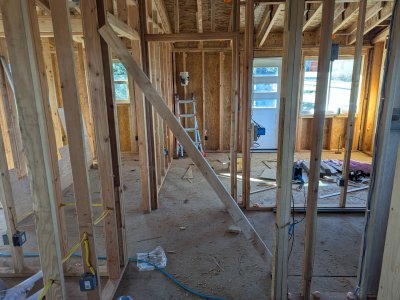
Just passed framing, shear wall, air seal inspections and good to insulate the house now!
I called my insulation contractor and he will be here Tuesday. Shit just got serious.
Now I need to scramble and get those last minute things done before it gets covered up.
 
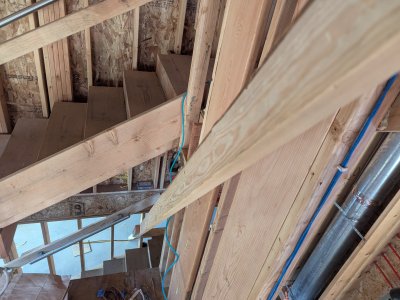
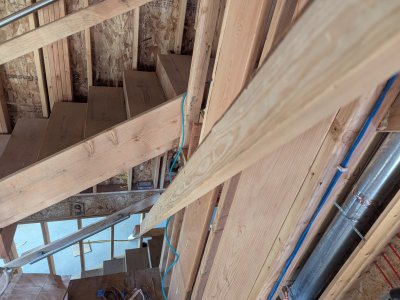
my lift company said they had to send the column as 1 piece 24'+ long. I had pictured a 2 piece with a slip joint. Oh crap!
I scabbed a pair of 12' 2x4 together and took a run at it.
There it sits on the basement floor, 93" past that step.
PXL_20260210_184532421.jpg

This is the top end, next to the permanent header, up under the temporary deck. It fits!
PXL_20260210_184526703.jpg

I put a pre-cut stud on floor 2 to emulate the angle and distance it would have to go to get pulled up and into place.
PXL_20260210_185257483.jpg

Piece of cake 🙂
I'll have a big crew and a chain fall to get it into place, then we will kick it around the shaft as we finish it.
290 pounds.
 
I have been mucking out ahead of the insulation crew that is coming next week, and now I have the boiler room guru from my company coming too. My ass is already dragging.
The good news is the State electrical inspector came by and passed the solar panel and inverter installation!
PXL_20260213_225050937.jpg
 
I worked about a half day at the house in preparation for an insane week of workings.
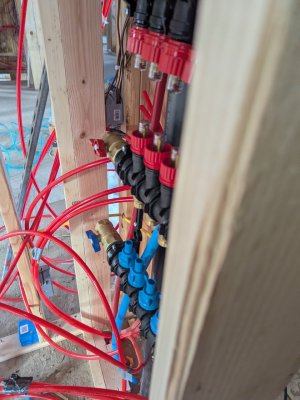
I furred out the back of the closet wall to get a little space from that ABS stack, and installed the 2x6 at the rough door opening for the metal door that will cover these manifolds. I'll slip the manifolds forward 3/4" with rips of plywood to get some knuckle room. Monday the boiler room specialist is coming to dial in the equipment room with sweat copper.
I left out the leftmost framing for those manifolds to leave room to get in the 1" PEX feeds. They are a ah heck to bend.
PXL_20260214_213012969.jpg
PXL_20260214_211453787.jpg
That will get covered with a 30 x 24 steel access door.
That is for 9 runs of 3/8" hydronic heat tubing, about 1800' of spaghetti.
The spaghetti is coming in for a landing some time next week. 🙂
 
I had the most wonderful experience with a contractor today.

They said they would be here today and they showed. They came with a big crew and got it done in one day, which was not expected. They took great care and did a good job. The building inspector came by to witness the shower pan flood test, and looked at their work and was impressed. He pointed out a few things and they had a great Convo about what was expected.
1 day to insulate the house. I wrote the check and will recommend them to anyone.
 
Always impressed by the professionals and how tight they keep it all.

Do you not have to worry about galvanic corrosion between the copper pipe clamps and the presumably zinc unistrut?
 
presumably anodized strut for just this purpose. There is galvie struts in the stack for fillers, but I got 3 sticks of anodized. it is that light gold color.
 
the rule of thumb is to test at 1.5 times the operating pressure. When I get the loops on the manifolds Monday I will test the whole thing at 30 PSI. Then go around with the soapy water spray bottle and look for bubbles, then wait a day.
My brother had to replace his water heater due to condo rules, and I have it for a temporary heat source for testing and setting up the loops. That will get done week after next.
The lift company agreement had some verbiage about me providing my own column. I had passed over that more than once, and when I went to pay the lightbulb turned on. I called my steel provider and got a price, and they deducted it from the purchase agreement.
The 24' 3x3x0.375 box tube is waiting for me to pick up. When my sheetrock crew is there I will get it and we will roll it in ( 290 # ) on his sheetrock cart and hoist it in with a chain fall.
This is huge, because I was having to leave these holes open.
PXL_20260210_184532421.jpg
Now they can rock the lid of the shaft and stairs with the safety platform in place, and then demo the platforms and bring in the column. We will work around it.
 
Big day. all the loops are connected, pressure tested, filled and flushed with water and ready to go.
PUD came out and changed the meter and we are making juice now baby!
PXL_20260304_162345108.jpg
 
floor heat is not the cheapest route for sure. DIY helps. if $$ is the only thing, it is hard to beat mini splits. I have a couple that were right around a grand each at the old house.
 
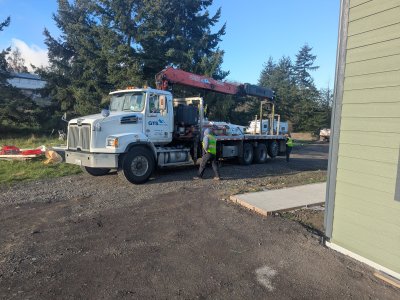
These guys showed up before I could finish my first cup of coffee.
PXL_20260305_162700052.jpg

PXL_20260305_162810679.jpg

PXL_20260305_162828329.jpg

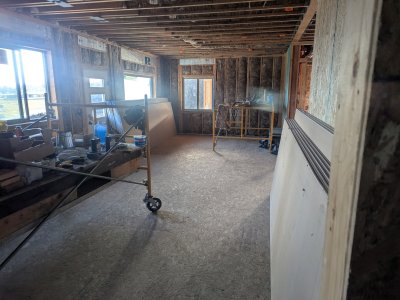
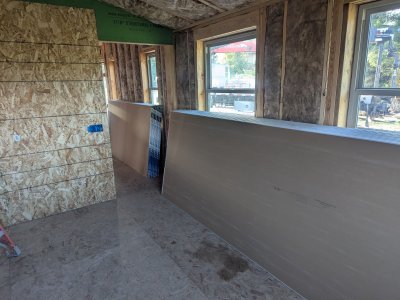
220 12' sheets of drywall stocked on 3 floors in one hour.
Day 1 solar was 41KWh on a cloudy spring day. GIGGITY!
 
Back
Top