
DisEnchantment
Golden Member
Speculate at will
Last edited:


I realize there was a lot of shady stuff going on for a long time. AMD was the first to 1ghz. AMD created the first 64bit CPU. AMD had the first native dual core CPU around 2005. The tables really started turning in favor of AMD around 2002 with Athlon XP. 32bit processors had security issues and Intel believed 64 bit CPU's was unnecessary.Intel deal with Dell, and also with HP, date from the Opteron 64, and even before, that long predate the FX era, Intel made all they can to keep AMD from entering the server market, HP aknowldged that they refused 200k free Opteron 64 from AMD to initiate manufacturing because of fear of Intel s coercition.
And now AMD is blowing Intel out of the server market, no bribes needed
I have a couple of their best..... the 9755 is an Intel killer
Yeah, well…
Ordered a (small) server for school. Restrained to 5000€ was not simple. Ended with an Intel thing. No choice.
Man, I’ll never get an Epyc, even at work.

It's a part for a very slow market.I wonder what's up with such a long time gap between Turin and Sorano.
It's a part for a very slow market.
How is this even a question
It's. a. slow. market.Earlier you introduce the new gen, the more you sell, the more market share you can take from the competitor.

apparently "zen 6" lp cores are derived from zen 5 with a topping of zen 6I think it makes sense that AMD decided that if they were gonna waste some die space on two low power cores, best not to make them almost completely useless like Intel's Meteor Lake LP cores. And I believe their strategy is always to do things that help them in future. So spending the effort to make these performant LP cores could pay itself big time if AMD incorporates these LP cores as normal E-cores along with Zen6c cores acting as P-cores in a very power efficient SKU.
Yes, though the architecture is slightly different.
What AMD says publicly and what they consider the PS5 to be internally are very different things. Upcoming CPUs with "Zen6LP" are another example where despite the name, it is considered "Zen5 with Zen6 ISA" internally.
Introduced? They gave merely a teaser.Maybe you missed out these, that were just introduced today - Sorano.

OT but it's really good to see Ryan Smith (you know from a long lost site called Anandtech?) doing articles once again
It's a telco part, launches like that are expected.
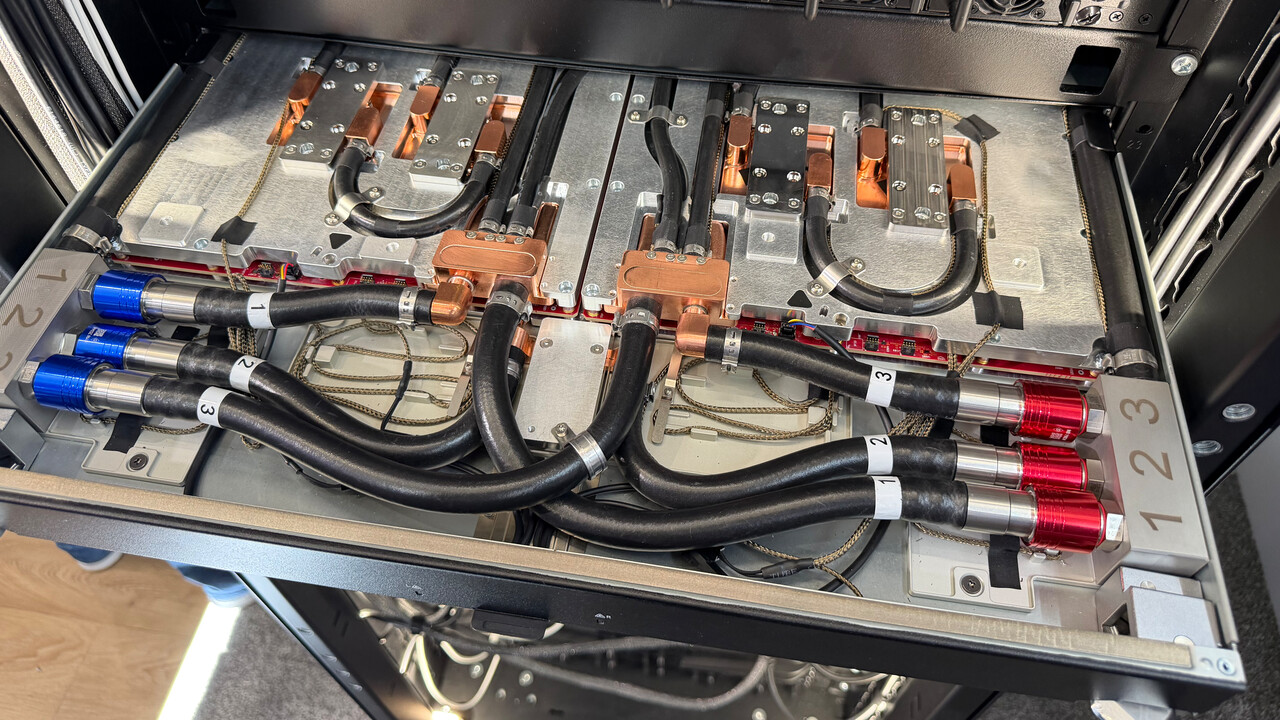
to bad, there wont be any real volume LOLFor the time Qualcomm s AI dedicated racks are Epyc equipped :
Rack-Scale-AI von Qualcomm: AI200 kommt mit AMD-CPUs, ab 2028+ dann eigene Oryon-CPU
Zum MWC 2026 hat Qualcomm Details zu neuen AI-Racks verraten. Aktuell und in naher Zukunft setzt man auf AMD-CPUs, erst 2028+ kommt Oryon.www.computerbase.de
Michael Larabel said:When taking the geometric mean of 555 benchmarks in total, the AMD EPYC 9745 was delivering about 90% the performance of its 128 core EPYC 9755 sibling. Considering that the EPYC 9745 has just 80% the TDP rating of the EPYC 9755, that's a nice showing for the EPYC 9745 with its dense cores. When pulling back to the 320 Watt lowest cTDP, it was around 98% the performance of the 400 Watt default.

That’s pretty good; the 9745 delivers 88% of the performance of the 9755 at 64% of the TDP.A few days ago, Phoronix posted a comparison of Zen 5 classic vs. Zen 5 dense (in their server incarnations):
- AMD EPYC 9755 (128 cores, Zen 5, 500 Watt TDP)
- AMD EPYC 9745 (128 cores, Zen 5C, 400 Watt TDP)
- AMD EPYC 9745 (128 cores, Zen 5C, 320 Watt cTDP)
AMD EPYC Turin 128 Core Comparison: EPYC 9745 "Zen 5C" vs. EPYC 9755 "Zen 5"
It also has half the L3.That’s pretty good; the 9745 delivers 88% of the performance of the 9755 at 64% of the TDP.
It also has half the L3.
Not at all.I wonder how hard AMD will be pushing V-Cache equipped Zen 6 CPUs
Yes it's for EDA/CFD/sims/yaddayadda. No changes since Milan-X.AMD showed Venice-X quite prominently for some Instinct AI / HPC markets.
Man you're funny.I wonder about general purpose servers for hyperscalers, how many will adopt Venice-X.
Not at all.
Normal SP7 Venice covers most of the market by itself.
Man you're funny.
Always projecting nerd wet dreams onto unrelated product roadmaps.
Brother the next reply there is literally me.This may not be the right thread, but what is your take on Venice Dense having more than 32 cores on the die? Mike Goldsmith commented on it a few days back:
No?You also said that there would not be any more V-Cache server CPUs
a) yes. kind of.And not only is V-Cache back (in Venice) but really integral part of Florence Dense.
Brother the next reply there is literally me.
Why are you doing this?
No?
I only ever said Turin-X was shelved in favour of MI300C.
The primary customer for -X parts is Azure HPC.
a) yes. kind of.
b) not really, no. Florence is very TBD.
You're free to click on my account whenever.Haha, I had it bookmarked, and my reply jumped (for me) ahead of yours...
CloudFlare and they don't work like that.There was another, 2nd tier hyperscaler who standardized on Genoa-X, which to me, was a clear indication there would be future V-Cache generations.
Please do not consider any AMD config real until it TO's.We will see if MLID leak holds, but Florence Dense would be a 2 die solution, no single die solution for the Dense part.
Right; although to those whose servers run specific workloads, it's useful to look at specific subsets of the benchmarks. (Also always consider dataset size, not just application.)That’s pretty good; the 9745 delivers 88% of the performance of the 9755 at 64% of the TDP.


